

6) Stealth Mini Awac to illuminate blind spots to Boeing 737 AEW&C
I am not sure if it is possible to put Large enough radar sensor within Anka-3's fuselage.

6) Stealth Mini Awac to illuminate blind spots to Boeing 737 AEW&C

This requires a certain volume and energy budget. AI25's APU can't provide such an energy already I think.Can't we place the Aselsan Aesa radar for Kaan on top of Anka 3 like a mini Embraer R-99
This requires a certain volume and energy budget. AI25's APU can't provide such an energy already I think.

We need to have a pool of names we assign to products in country level to avoid duplication. We can not call a tank and plane the same thing.
Some kind of industry product naming platform.

It is within it’s mission envelopes and mission parameters.I thought the purpose of Süper şimşek was to be visible.To produce in large numbers and spend the enemy's valuable air defense missiles.
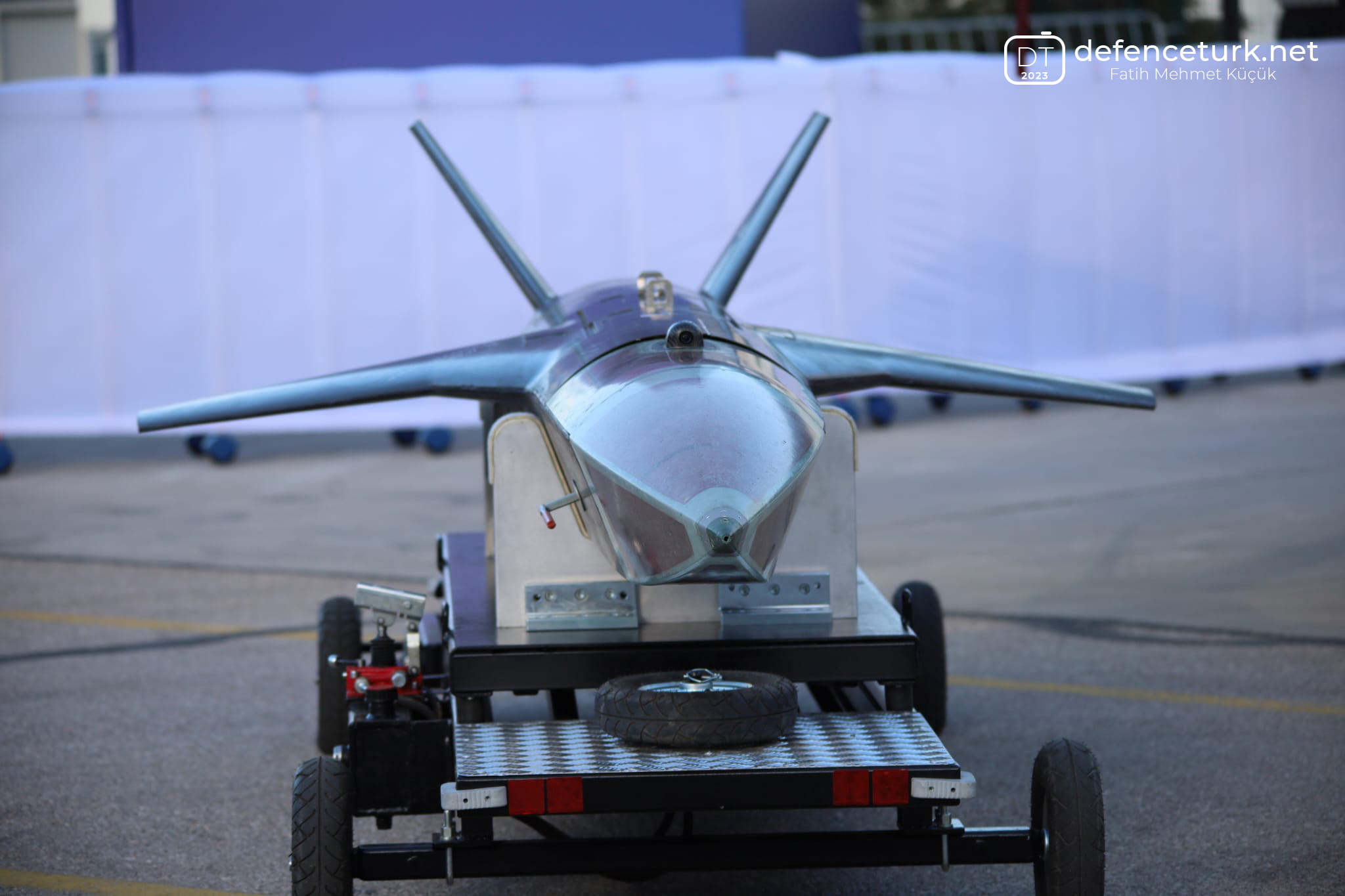
 www.defenceturk.net


1-ANKA-3 will eventually be scaled up to fill that roleWhat other versions could we have for Anka 3?
1) Stealth Unmanned Bomber
2) Stealth Electronic Attack/Jammer
3) Stealth Electronic Support/Signals intelligence
4) Stealth visual intelligence and target painting
5) Refueling
6) Stealth Mini Awac to illuminate blind spots to Boeing 737 AEW&C
???
Your humble opinion is correct to a degree. Yet may need some additions.My humble opinion is, if warhead weight is 35kg it does not necessarily carry 35kg explosive.
We know that usually a good amount of weight goes to the warhead casing.
For example, MK-83 is basically a warhead with fuze. It has total weight of 460kg yet has a filling weight of 202kg explosive only.
Similarly, afaik Tomahawk's warhead has a total weight of 1000lbs, but has a filling weight of 450lbs only.
View attachment 59056
Here you guys can see (blue) warhead casing in the details.
So, I suspect if Super-Simsek's warhead is 35kg and it is a blast fragmentation, then its filling weight is porbbaly around 20kg. Which would be 2 times more powerful comapred to 155mm shells. (Modern designs consists of 10kg HE.)
Super Simsek does not land in a conventional manner. Like its smaller sibling it can come back to base and do a parachute landing. So if launched from a ship, it will return and land close by at sea where it can be recovered from.I asked to CHAT GPT:
"Süper Şimşek could land on TCG ANADOLU?"
Answer:
While it is true that the Turkish Hürjet fighter jet has the capability to land on the TCG Anadolu, it does not necessarily mean that the Süper Şimşek combat drone will also be able to land on the same vessel. The TCG Anadolu is primarily designed to support helicopter operations, and it may not have the necessary infrastructure or equipment for the landing and takeoff of combat drones. Additionally, the Süper Şimşek is a high-speed drone specifically designed for combat purposes, and its landing requirements may differ from those of a manned fighter jet like the Hürjet. Ultimately, the decision of whether or not the Süper Şimşek can land on the TCG Anadolu would depend on various factors, including the ship's capabilities and the specific design and requirements of the drone.
Your humble opinion is correct to a degree. Yet may need some additions.
The reason it is called a warhead is because the job it is supposed to do and the damage it is supposed to cause is done by the entirety of the warhead itself.
The casing, what it contains as explosive, where it is to be detonated, all add up to to the explosive and damaging power it inflicts. How constricted the explosive is, how much oxygen it can have, what sort of damage is needed etc etc all play a part.
Take for example an old anti ship missile like Penguin. It has a warhead weight of 120kg. it’s total weight is around 380kg. Within this 120kg warhead the actual explosive PBXN-109 is 43kg in weight. But this warhead has to penetrate through the hull of a ship and has to explode with a delay inside the ship’s hull. During this it has to be robust enough to withstand the initial impact and then inside the hull has to explode so that all the parts of the warhead will fragment and cause extensive explosive damage to ships infrastructure.
Whereas in an anti ship missile explosive chemical weight is typically more than 1/3rd of the total weight of a warhead, in an artillery round, which is effectively almost the warhead itself, the explosive chemical’s weight is around 1/6th to 1/5th. It is filled with a mixture of RDX-TNT. (A 43kg M107HE shell has 6.6 kg explosive, a 47kg M795HE shell has 9.1kg explosive) Depending on how the shell is to detonate and explode the mixture content, the shell construction is designed.
An artillery shell explodes in open air. Therefore it has to be designed accordingly. An Anti ship warhead explodes inside the hull of a ship in a confined space. So it has to be designed accordingly too.
Blast kinematics of the two are very different.
Harpoon AGM-84 missile has a warhead of 220kg in weight; But contains 97kg of chemical explosives. This explosive contains TNT and Destex which is specially effective in moist/wet surroundings.


Ever since KE was announced, I've given a lot of thought to the LOS issue when managing supersonic drones like KE.Canik is in talks with Baykar to integrate 30x113mm cannon into Kızılelma. The mentioned autocannon is ADEN autocannon from AEI systems


