• Forum restore complete (see latest announcement thread)

TR UAV/UCAV Programs | Anka - series | Kızılelma | TB - series

dBSPL

Experienced member
Think Tank Analyst
DefenceHub Ambassador
Messages
2,871
Reactions
123 14,519
Nation of residence
Turkey
Nation of origin
Turkey
A few screenshots from the KE fleet autonomy user interface were shared:

ke1.JPG

ke2.JPG

(F35 :) )
ke3.JPG

ke4.JPG


source: gdh defence
 
Last edited:

dBSPL

Experienced member
Think Tank Analyst
DefenceHub Ambassador
Messages
2,871
Reactions
123 14,519
Nation of residence
Turkey
Nation of origin
Turkey
A few screenshots from the KE fleet autonomy user interface were shared:

View attachment 71491
View attachment 71492
(F35 :) )
View attachment 71493
View attachment 71494

source: gdh defence


The combination of pre-loaded map information, data from navigation systems, data from other manned jets and air control aircraft in the same combat network, and all radar identification and electro-optical imagery of the aircraft in the fleet, processed in real time and virtualized on a common screen is a monumental target. And this capability makes it possible for multiple unmanned jets to be operated and managed, perhaps by a single operator.

Imagine these interfaces on the IMD on the surfaces in front of the Hürjet co-pilot. If the targeted level of autonomy and sensor fusion can be achieved, these unmanned jets could provide an incredible multiplier to the capability of existing manned jets. On the other hand, if the KE can achieve supercruise capability with a twin-engine configuration and future developments, the concept demonstrated on the aircraft carrier mock-up could be a much more ambitious approach than we think.
 

Quasar 

Contributor
Moderator
Messages
920
Reactions
54 4,037
Nation of residence
Nethelands
Nation of origin
Turkey
The combination of pre-loaded map information, data from navigation systems, data from other manned jets and air control aircraft in the same combat network, and all radar identification and electro-optical imagery of the aircraft in the fleet, processed in real time and virtualized on a common screen is a monumental target. And this capability makes it possible for multiple unmanned jets to be operated and managed, perhaps by a single operator.

Imagine these interfaces on the IMD on the surfaces in front of the Hürjet co-pilot. If the targeted level of autonomy and sensor fusion can be achieved, these unmanned jets could provide an incredible multiplier to the capability of existing manned jets. On the other hand, if the KE can achieve supercruise capability with a twin-engine configuration and future developments, the concept demonstrated on the aircraft carrier mock-up could be a much more ambitious approach than we think.
and imagine the concept demonstrated on the aircraft carrier mock-up in a carrier group including TF 2000 and MİLDEN .... my only conern is the lack of a dedicated carrier based tactical battle management airborne early warning and command and control aircraft .... or may be this holistic battle management & command and control role can be handled alone by surface assets with the help of several unmaned airborne drones asigned with early warning ....may be it would be too much task and data for Hürjet and Hürjet co-pilot....or may be several localized and narrowed responsibility areas in battle management & command and control... in any case the number of manned and unmanned aircrafts we should keep airbone will be potentially more than the old fashion carrier group
 
Last edited:

dBSPL

Experienced member
Think Tank Analyst
DefenceHub Ambassador
Messages
2,871
Reactions
123 14,519
Nation of residence
Turkey
Nation of origin
Turkey
and imagine the concept demonstrated on the aircraft carrier mock-up in a carrier group including TF 2000 and MİLDEN .... only conern is the lack of a dedicated carrier based tactical battle management airborne early warning and command and control aircraft .... or may be this holistic battle management & command and control role can be handled alone by surface assets with the help of several unmaned airborne drones asigned with early warning .... it would be too much task and data for Hürjet and Hürjet co-pilot....may be several localized and narrowed responsibility areas in battle management & command and control
From what I can understand, the approach that has been put forward is a distributed architecture. This system need to provide a secure, uninterrupted, real-time common operational and tactical level display with high bandwidth and encryption. An extraordinarily difficult work. But, We are currently one of the few countries in the world that can develop an Air Warning and Command Control System with its own resources. The Hevalsan solution has successfully passed all Assurance Verification and Validation-AV&V tests, which is a NATO Certification; it has a tremendous architecture that can be integrated with other force data networks, and can be integrated with many other National and NATO information sources such as National Airborne Warning and Command Control System Sensor(s)/Radar Network, Intelligence, Satellite Supported Ballistic Missile Warning Systems, Meteorology, ATC Systems. Probably all links will be run on this main system.
 

Shtr

Committed member
Messages
167
Reactions
6 303
Nation of residence
Turkey
Nation of origin
Turkey
I guess this is not shared yet.
Baykar has developed BM100 engine for the TB2.
200 units of production needed per year and is in line at reaching this goal next year.


This seems very interesting. They announced a few months ago that they are working on this engine and now they are in serial production. Any information about this?
 
Last edited by a moderator:

No Name

Contributor
Messages
561
Reactions
8 570
Nation of residence
Australia
Nation of origin
Afghanistan
The combination of pre-loaded map information, data from navigation systems, data from other manned jets and air control aircraft in the same combat network, and all radar identification and electro-optical imagery of the aircraft in the fleet, processed in real time and virtualized on a common screen is a monumental target. And this capability makes it possible for multiple unmanned jets to be operated and managed, perhaps by a single operator.

Imagine these interfaces on the IMD on the surfaces in front of the Hürjet co-pilot. If the targeted level of autonomy and sensor fusion can be achieved, these unmanned jets could provide an incredible multiplier to the capability of existing manned jets. On the other hand, if the KE can achieve supercruise capability with a twin-engine configuration and future developments, the concept demonstrated on the aircraft carrier mock-up could be a much more ambitious approach than we think.
Wouldn't the navalized Hurjet's massive radar signature mean that it sticks out more than its drone wingmen, thus increasing the likelihood of it getting shot down before any of its drones are even detected?

Although the concept is great, but the Hurjet's central role as the brain may leave much to be desired.
 

boredaf

Experienced member
Messages
2,266
Solutions
1
Reactions
42 6,646
Nation of residence
United Kingdom
Nation of origin
Turkey
Wouldn't the navalized Hurjet's massive radar signature mean that it sticks out more than its drone wingmen, thus increasing the likelihood of it getting shot down before any of its drones are even detected?

Although the concept is great, but the Hurjet's central role as the brain may leave much to be desired.
It is an exercise in futility, especially when you consider our aircraft carrier will launch at around 2040s. Not only there will be more 5th gen planes around, who knows how the anti-air (ground to air or air to air) missiles and radar are going to improve by that time. And, there is a chance that even 6th gen planes will start flying by then.

Meanwhile, we are talking about using a 4th gen trainer turned fighter on a carrier worth billions of dollars. Total waste of time and resources, even in drone control role because these drones will have blos communication at any rate or will be more autonomous than they are today.
 

uçuyorum

Contributor
Messages
1,224
Reactions
15 1,988
Nation of residence
Turkey
Nation of origin
Turkey
It is an exercise in futility, especially when you consider our aircraft carrier will launch at around 2040s. Not only there will be more 5th gen planes around, who knows how the anti-air (ground to air or air to air) missiles and radar are going to improve by that time. And, there is a chance that even 6th gen planes will start flying by then.

Meanwhile, we are talking about using a 4th gen trainer turned fighter on a carrier worth billions of dollars. Total waste of time and resources, even in drone control role because these drones will have blos communication at any rate or will be more autonomous than they are today.
Even if we get a 5th gen naval fighter there will be a need for a naval trainer. So naval hurjet is already a prerequisite
 

boredaf

Experienced member
Messages
2,266
Solutions
1
Reactions
42 6,646
Nation of residence
United Kingdom
Nation of origin
Turkey
Even if we get a 5th gen naval fighter there will be a need for a naval trainer. So naval hurjet is already a prerequisite
Trainer is completely different than putting it on the carrier and using it though. That is what I'm talking about here.
 

Quasar 

Contributor
Moderator
Messages
920
Reactions
54 4,037
Nation of residence
Nethelands
Nation of origin
Turkey
It is an exercise in futility, especially when you consider our aircraft carrier will launch at around 2040s. Not only there will be more 5th gen planes around, who knows how the anti-air (ground to air or air to air) missiles and radar are going to improve by that time. And, there is a chance that even 6th gen planes will start flying by then.

Meanwhile, we are talking about using a 4th gen trainer turned fighter on a carrier worth billions of dollars. Total waste of time and resources, even in drone control role because these drones will have blos communication at any rate or will be more autonomous than they are today.
fair point...my only objection is you are keeping current HÜRJET as a constant and teleporting it to 2040's battlefield. I think eventually HÜRJET may evolve into a project like MİLGEN i.e just a general desingnation you know what I mean .... your single engine (TF 35000) or hopfully twin engine carrier based aircraft ...... sure this is a speculation but a speculation dictated by logic or just our wishfull thinking :devilish:
 

boredaf

Experienced member
Messages
2,266
Solutions
1
Reactions
42 6,646
Nation of residence
United Kingdom
Nation of origin
Turkey
fair point...my only objection is you are keeping current HÜRJET as a constant and teleporting it to 2040's battlefield. I think eventually HÜRJET may evolve into a project like MİLGEN i.e just a general desingnation you know what I mean .... your single engine (TF 35000) or hopfully twin engine carrier based aircraft ...... sure this is a speculation but a speculation dictated by logic or our wishfull thinking :devilish:
But then that jet is not Hürjet, you would need an almost completely new design as its current design is focused on what it's primary purpose is, a trainer jet. Instead of doing that, wasting time and resources on redesigning Hürjet or using an underpowered jet on our carrier we would be much better of with making a single TF35k Kaan variant that we can use on Kaan (after its design process is completely done).

Not to mention we don't even have an engine or even an engine project fit for Hürjet in combat roles and we don't even know we can export engines for that purpose. This insistence on Hürjet is just as speculative as single engine naval Kaan.
 

boredaf

Experienced member
Messages
2,266
Solutions
1
Reactions
42 6,646
Nation of residence
United Kingdom
Nation of origin
Turkey
I wonder when people will stop comparing different Jet Fighter generations like rock paper scissors.
Tell me what advantage a naval Hürjet fighter, not a trainer this discussion was never about that to begin with, would have over a naval Kaan variant, whether as it is now or a single engine variant, especially in 2040s.
 

boredaf

Experienced member
Messages
2,266
Solutions
1
Reactions
42 6,646
Nation of residence
United Kingdom
Nation of origin
Turkey
Maybe you should first understand that the striking force of that Aircraft Carrier will be KE and ANKA 3/4. Both are stealth, will have AESA radars and A-A weapons. A Hürjet will be at least 100km behind those drones, are there any A-A weapons with a NEZ greater than 100km? And good luck trying to shoot down another Jet while defending missiles shot from 5th gen aircraft like drones. Also don't forget EW pods.
Then what is the point of Hürjet, at all? These drones do not need Hürjet to be controlled now, they certainly won't in the future either. And you're talking as if nothing will ever change in the 10+ years while we wait for this carrier. Maybe you should "understand" that if we're going put so much into making a carrier we need to futureproof it instead of using a jet for a mission that might or might no be relevant, let alone needed.
 

boredaf

Experienced member
Messages
2,266
Solutions
1
Reactions
42 6,646
Nation of residence
United Kingdom
Nation of origin
Turkey
Which missions? Are you in the Airforce? Do you have expertise in that field? Are you in a position to be able to evaluate that?
Did you even read the comments that started this chain? Let me explain, we were talking about whether Hürjet would make an appropriate choice for command centre in air for our future stealth drones, KE and Anka-3/4, which would be a mission for Hürjet to accomplish and if Hürjet was based on an aircraft carrier that would be mean its mission would be part of the mission of our carrier.

And you are talking as if only the assets of the adversaries will change.
This is not about whose capabilities are going to get awesome with time. This is about Hürjet and it is limited by its design, it is a trainer with a design that is not stealthy or capable of carrying big payloads. You cannot change that without changing the plane drastically. And if we were going to change a plane to fit it into our carrier (in any other role other than as a trainer) spending time and resources to redesign a plane to use on the carrier why on earth would we pick Hürjet? A plane that we don't have an engine for, don't even have an engine project for, that would stick out like a sore thumb among stealth drones and one that would barely be able to carry enough ordinance for effective sortie rates. Which would you pick if you were given a choice to turn one of Hürjet and Kaan into a plane for our carrier?

Honestly, you are not even giving proper reasons or arguments, you're only arguing to argue and your subtle hostility against me is seriously getting boring.
 
Last edited by a moderator:

Yasar_TR

Experienced member
Staff member
Administrator
Messages
4,270
Reactions
258 22,303
Nation of residence
United Kingdom
Nation of origin
Turkey
Guys! Let’s not get carried away please.
Instead of getting personal, focus on the subject in hand.
Not everybody will be of the same opinion as you. Taking that in to account, please discuss yor views civilly without being nasty to each other.
 

Quasar 

Contributor
Moderator
Messages
920
Reactions
54 4,037
Nation of residence
Nethelands
Nation of origin
Turkey
Guys! Let’s not get carried away please.
Instead of getting personal, focus on the subject in hand.
Not everybody will be of the same opinion as you. Taking that in to account, please discuss yor views civilly without being nasty to each other.
in fact in a way we are all reading the very same opinion ... just may be from diffrent perspectives
 

Yasar_TR

Experienced member
Staff member
Administrator
Messages
4,270
Reactions
258 22,303
Nation of residence
United Kingdom
Nation of origin
Turkey
First of all please be reminded that this is the UAV/UCAV thread.

Anka 4 has been mentioned above. Does anyone know what Anka-4 is?

If memory serves, the first time it was mentioned was by Temel Kotil, when he was talking about Anka-3. He said something about producing the supersonic version of Anka-3 and that there would also be Anka-4.

We all know that Anka-3 is a flying wing, and technically it is not feasible to produce a supersonic flying wing. So if we are to produce a supersonic Anka-4, this will have to be a very different plane. As we know that there is no similarity in the design features of Anka-2 and Anka-3, we may have to assume that Anka-4 could be just as different.

Any UCAV utilised on a carrier, at the moment, is a secondary power projection weapon. All 65000ton class carriers (like Charles DeGaulle, QE2) use manned aircraft as their primary weapon, be it a fighter aircraft or an ASW helicopter. But the rapid increase in the development of capable UCAVs in a decade or so may change the situation altogether.
It is good that a study and development of a national aircraft carrier project has been started. As the use of various air platforms evolve, so will the national aircraft project.

It doesn’t logically make sense to deploy a non-stealth aircraft on a modern carrier in the 2040’s. But with today’s capabilities, one has to decide on a manned platform that is currently available to have a starting point of reference.

 

Quasar 

Contributor
Moderator
Messages
920
Reactions
54 4,037
Nation of residence
Nethelands
Nation of origin
Turkey
The combination of pre-loaded map information, data from navigation systems, data from other manned jets and air control aircraft in the same combat network, and all radar identification and electro-optical imagery of the aircraft in the fleet, processed in real time and virtualized on a common screen is a monumental target. And this capability makes it possible for multiple unmanned jets to be operated and managed, perhaps by a single operator.

Imagine these interfaces on the IMD on the surfaces in front of the Hürjet co-pilot. If the targeted level of autonomy and sensor fusion can be achieved, these unmanned jets could provide an incredible multiplier to the capability of existing manned jets. On the other hand, if the KE can achieve supercruise capability with a twin-engine configuration and future developments, the concept demonstrated on the aircraft carrier mock-up could be a much more ambitious approach than we think.
During the firing test, target allocation and control were performed by HÜRJET.


boredaf

Experienced member
Messages
2,266
Solutions
1
Reactions
42 6,646
Nation of residence
United Kingdom
Nation of origin
Turkey
Okay, this one is a bit of a headscratcher (at least for me).

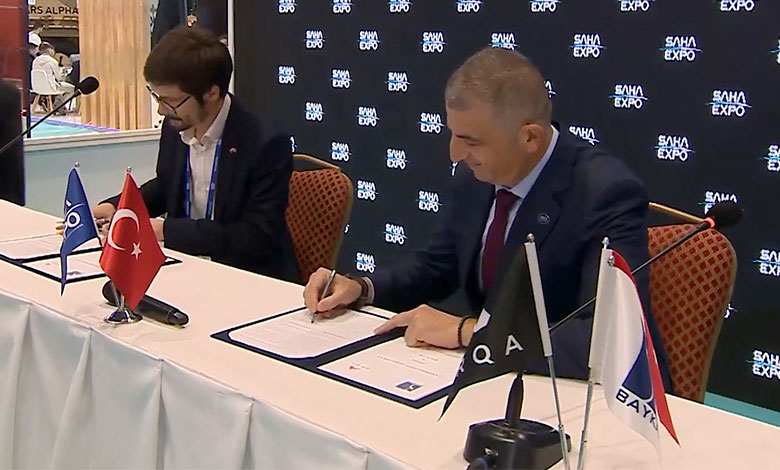
Croatian FPV Drone for Bayraktar TB2 SIHA: Signed


BAYKAR signed a cooperation agreement for the integration of FPV Drones produced by the Croatian company ORQA into the Bayraktar TB2 SIHA platform during SAHA EXPO.

First of all, I'm not really sure what application FPV quad drones, somehow, launched from a MALE drone like TB-2 would achieve. Smaller loitering munition, sure that makes perfect sense, but a quad is just weird so I'm really curious about what their goal might be. Second, the firm they signed the agreement with seems to have focused on controllers and visors for FPV drone controls rather than drones themselves so far. As in, they don't have single drone on their website as a product, the drones they do show is from other companies. Wonder what will turn out of this agreement.
 
Top Bottom