
Latest Thread
- Bangladesh Opinion Bangladesh’s intelligence challenge
- Iran’s Long Game in Türkiye: From Political Islam to the Post-Erdoğan Era
- Open-source AI for exploiting cyber vulnerabilities
- Engineering Atomic Machines: Matter Compiler
- Breaking News Turkish and Greek defence officials meet for "Confidence Building Measures"
You are using an out of date browser. It may not display this or other websites correctly.
You should upgrade or use an alternative browser.
You should upgrade or use an alternative browser.


The more Turkiye develops the more depressed and disappointed these guys seem to be. They seem to be less and less excited by it all. In the early videos they used to laugh a lot when talking about Turkish develops, used to softly mock a lot. Now the deep breaths of frustration seem to be ever prevalent.
The assessments here must be viewed in a differentiated manner. The analysts' reluctance stems primarily from the fact that they lack clear technical verification as to whether the missile was actually guided exclusively by the drone's on-board radar or whether a handover may have taken place via an F-16 or AWACS aircraft in the vicinity. They did not express this doubt openly, but hinted at it between the lines. This is typical of sceptical observers who are not familiar with the Turkish defence industry in detail.
Like many European analysts, they continue to assume that Turkey is a very capable industrial workbench, but has only limited capacity for truly independent development and deployment of complex weapon systems. However, it is precisely this assumption that has been noticeably shaken here. They themselves have acknowledged that this is an extraordinary technological step.
It is understandable that this does not result in effusive praise for the Turkish defence industry: there is simply no emotional or national identification with the country. If the US were to present the NGAD programme in a similar way tomorrow with something completely new, people would also be impressed and would recognise the achievement – but without resorting to jubilant reports. This sober assessment is ultimately normal.


Where do you see the lens? also, the rear landing gear is not covered (should increase the RCS quite a bit).
external BVR missile doest help as well but.... test flights.... please look on the right side of the vertical stabilizer on top of the right wingWhere do you see the lens? also, the rear landing gear is not covered (should increase the RCS quite a bit).
Last edited:
YusufKnight
Member


✈️ #BayraktarTB3 ⚓️ TCG ANADOLU 🚤 ALBATROS-S 🛫 Bayraktar TB3 Üzerinden KİDA Kontrol Testi 🛫 KUSV Control Test via Bayra…
Selçuk Bayraktar - NSosyal
 sosyal.teknofest.app
More TB3 action from TCG Anadolu. Take-off with heavier and heavier payloads!


The TB-3 has given this vessel the much sought self defence and assault capability that it really was partly lacking due to the navy not heaving enough navalised helicopters. The second hand AH-1W attack helicopters taken from the army are so old (nearly 40 years) that they should really be retired. There aren’t enough Seahawks to support this ship and all the other frigates and corvettes we keep building.✈️ #BayraktarTB3 ⚓️ TCG ANADOLU 🚤 ALBATROS-S 🛫 Bayraktar TB3 Üzerinden KİDA Kontrol Testi 🛫 KUSV Control Test via Bayra…
Selçuk Bayraktar - NSosyal
More TB3 action from TCG Anadolu. Take-off with heavier and heavier payloads!
But the TB3 can perform many of the lighter missions of a Seahawk and takes the burden off of it, when it comes to self defence and surface attack. It can be airborne for much longer periods to give intelligence and defensive cover.
If only KE could land on this boat too. Then as a light version of KE, it would give a partial fighter-aircraft cover and assault capability to this ship.
But they need arrester wires fitted to Anadolu, for that to happen.
I wouldn’t be very happy if Leonardo and Baykar manage to do that on the Italian carrier Cavour and LHD Trieste before us.
Cavour
Trieste
‘
Last edited:
Here is what I found about Kızılelma live fire test in Japanese, I am sure there are more coverage,
 milirepo.jp
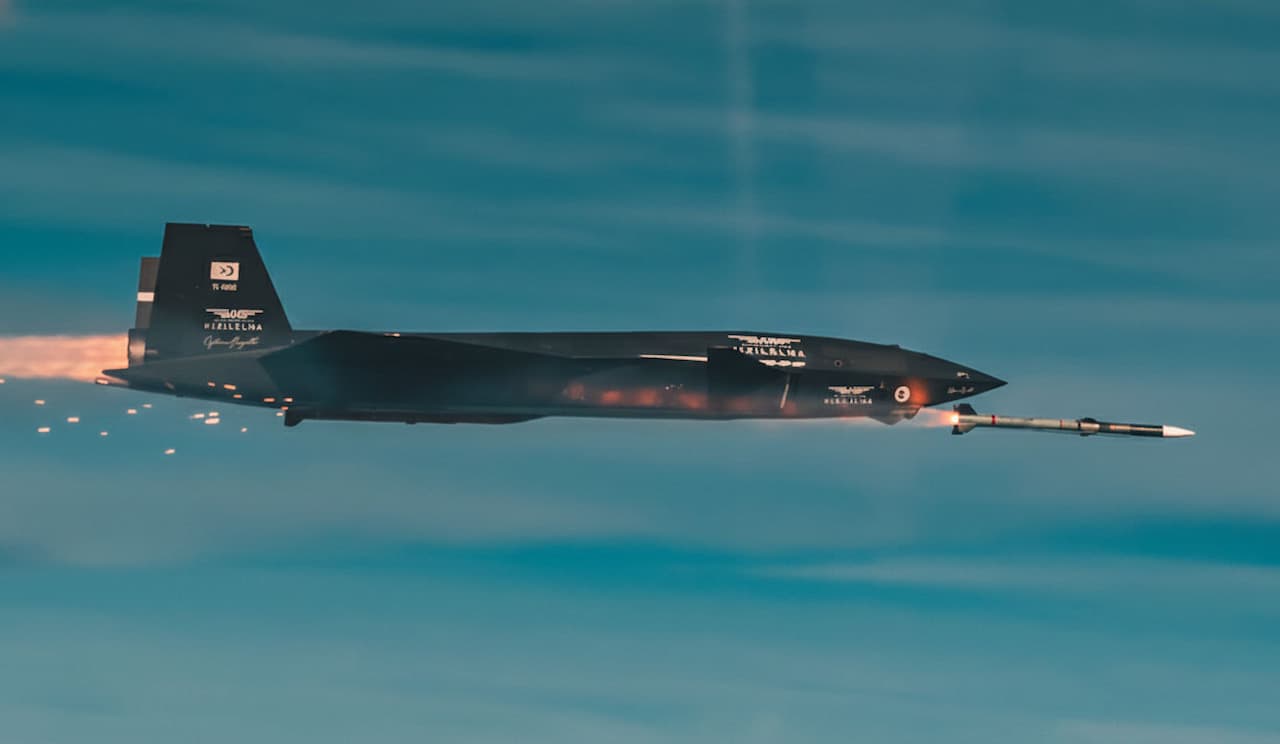
On November 30, 2025, Turkey's leading defense company, Baykar, announced that its unmanned combat air vehicle (UCAV), Bayraktar KIZILELMA, successfully conducted a groundbreaking air-to-air missile test at a firing range off the coast of Sinop on the Black Sea coast. The test marked a significant milestone in aviation and military history, marking the world's first air-to-air kill by a drone against a jet-powered target using beyond visual range (BVR).** The test used a domestically developed radar and missile to detect, track, and successfully destroy a jet-powered target with an air-to-air missile fired from beyond visual range (BVR).
milirepo.jp
On November 30, 2025, Turkey's leading defense company, Baykar, announced that its unmanned combat air vehicle (UCAV), Bayraktar KIZILELMA, successfully conducted a groundbreaking air-to-air missile test at a firing range off the coast of Sinop on the Black Sea coast. The test marked a significant milestone in aviation and military history, marking the world's first air-to-air kill by a drone against a jet-powered target using beyond visual range (BVR).** The test used a domestically developed radar and missile to detect, track, and successfully destroy a jet-powered target with an air-to-air missile fired from beyond visual range (BVR).
 topics.smt.docomo.ne.jp
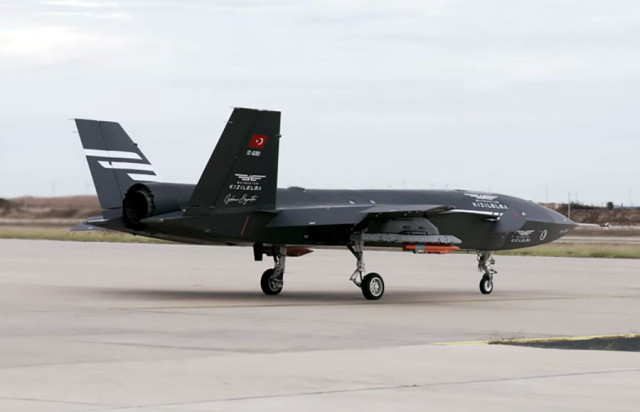
On November 20, 2025, Turkish defense company Baikal announced that its unmanned combat aircraft, the Bayraktar Kizil Elma, locked on to a Turkish Air Force F-16 fighter jet during a flight test, and was confirmed as having been shot down in a simulated attack using a domestically produced air-to-air missile.
The Kizil Elma is a stealthy, jet-powered unmanned aircraft with reportedly a maximum speed of approximately 900 km/h, and while it is not a supersonic aircraft, it is said to be highly maneuverable. Future operations using aircraft carriers and supersonic flight are also being considered.
During this flight test, the target F-16 was locked on using Turkey's domestically produced AESA radar, MURAD, and a direct hit was confirmed in a simulated attack using the domestically produced Gökdogan air-to-air missile.
The firing was conducted from a distance of approximately 48 km, in a beyond-visual-range (BVR) combat environment. This marks an important milestone, demonstrating that the aircraft is an unmanned aircraft equipped with beyond-visual-range air-to-air attack capabilities and is capable of shooting down manned fighter jets.
It also flew in formation with an F-16, confirming its ability to operate in conjunction with manned fighter jets.
Baikal has indicated that it may deliver the Kizil Elma to the Turkish military as early as 2026. If mass production is realized, this would mark the beginning of mass production of this type of unmanned fighter jet, ahead of aerospace powers such as the United States, Russia, and China.

 news.nifty.com
On November 20, 2025, Turkish defense company Baikal announced that its unmanned combat aircraft, the Bayraktar Kizil Elma, locked on to a Turkish Air Force F-16 fighter jet during a flight test, and was confirmed as having been shot down in a simulated attack using a domestically produced air-to-air missile.
news.nifty.com
On November 20, 2025, Turkish defense company Baikal announced that its unmanned combat aircraft, the Bayraktar Kizil Elma, locked on to a Turkish Air Force F-16 fighter jet during a flight test, and was confirmed as having been shot down in a simulated attack using a domestically produced air-to-air missile.
The Kizil Elma is a stealthy, jet-powered unmanned aircraft with reportedly a maximum speed of approximately 900 km/h, and while it is not a supersonic aircraft, it is said to be highly maneuverable. Future operations using aircraft carriers and supersonic flight are also being considered.
During this flight test, the target F-16 was locked on using Turkey's domestically produced AESA radar, MURAD, and a direct hit was confirmed in a simulated attack using the domestically produced Gökdogan air-to-air missile.
The firing was conducted from a distance of approximately 48 km, in a beyond-visual-range (BVR) combat environment. This marks an important milestone for the aircraft, demonstrating that it is an unmanned aircraft with beyond-visual-range air-to-air attack capabilities capable of shooting down manned fighter jets.
It also flew in formation with an F-16, confirming its ability to operate in conjunction with manned fighter jets.
Baikal has indicated that it may deliver the Kizil Elma to the Turkish military as early as 2026. If mass production is realized, this type of unmanned fighter jet will be the first to move into mass production, ahead of aerospace powers such as the United States, Russia, and China. (Norimono News Editorial Department)

 aviation-space-business.blogspot.com
Turkish industry and media have praised a live-fire test in which a Qizil Elma unmanned combat aerial vehicle (UCAV) used a Turkish-made air-to-air missile to destroy a target drone. Turkey claims the test marked the first time a UCAV fired a radar-guided air-to-air missile. However, unresolved questions remain about how the actual engagement unfolded, particularly the extent to which the UCAV was controlled by a manned fighter.
Aside from radar-guided missiles, the idea of drones firing air-to-air missiles is by no means new. In 2002, an emergency development program equipped the U.S. Air Force's MQ-1 Predator drone with an infrared-guided AIM-92 Stinger air-to-air missile. A Stinger-equipped Predator attacked an Iraqi MiG-25 Foxbat but was shot down by a fighter. The United States has also long explored the idea of using the MQ-9 Reaper in air-to-air missions, at least for self-defense. In a 2017 test, a Reaper successfully shot down a target drone with an AIM-9X Sidewinder air-to-air missile. Earlier this year, an MQ-9 attempted to intercept an unidentified flying object off the coast of Yemen in 2024, believed to be the first time a Reaper engaged any type of aerial target in a live-fire environment.
The Turkish test took place on November 28 and was announced yesterday. Video released by the Qizil Elma's manufacturer, Baykal, shows the UCAV (specifically, aircraft number PT-5) taking off alongside four Turkish Air Force F-16 fighter jets. Five F-16s participated in the live-fire test, including one serving as a chase aircraft for safety. The Akinci high-altitude, long-endurance UCAV also performed a pursuit mission.
トルコ無人戦闘機KIZILELMAが有視界外から空対空ミサイルでジェット標的を初撃墜
トルコの先進的な軍需企業Baykar社は2025年11月30日、同社が開発した無人戦闘機(UCAV)Bayraktar KIZILELMA(クズルエルマ)が、黒海沿岸のシノプ沖射撃場において、画期的な空対空ミサイル発射試験に成功したと発表した。この試験は、国産のレーダーとミサイルを用い、ジェット機動を行う標的機を探知、追尾し、視界外(BVR: Beyond Visual Range)から発射した空対空ミサイルで見事に撃破するという、航空・軍事史における「世界初、ジェット動力標的に対する無人機によるBVR空対空キル」**を達成した重要なマイルストーンとして位置づけられている。
milirepo.jp
アメリカや中国などをリード?「無人戦闘機」が対空ミサイルを発射し 有人機のF-16を撃墜扱いに トルコ(乗りものニュース)|dメニューニュース
有人機との飛行試験で実施 トルコの防衛企業バイカルは2025年11月20日、無人戦闘機「バイラクタル・クズル…
On November 20, 2025, Turkish defense company Baikal announced that its unmanned combat aircraft, the Bayraktar Kizil Elma, locked on to a Turkish Air Force F-16 fighter jet during a flight test, and was confirmed as having been shot down in a simulated attack using a domestically produced air-to-air missile.
The Kizil Elma is a stealthy, jet-powered unmanned aircraft with reportedly a maximum speed of approximately 900 km/h, and while it is not a supersonic aircraft, it is said to be highly maneuverable. Future operations using aircraft carriers and supersonic flight are also being considered.
During this flight test, the target F-16 was locked on using Turkey's domestically produced AESA radar, MURAD, and a direct hit was confirmed in a simulated attack using the domestically produced Gökdogan air-to-air missile.
The firing was conducted from a distance of approximately 48 km, in a beyond-visual-range (BVR) combat environment. This marks an important milestone, demonstrating that the aircraft is an unmanned aircraft equipped with beyond-visual-range air-to-air attack capabilities and is capable of shooting down manned fighter jets.
It also flew in formation with an F-16, confirming its ability to operate in conjunction with manned fighter jets.
Baikal has indicated that it may deliver the Kizil Elma to the Turkish military as early as 2026. If mass production is realized, this would mark the beginning of mass production of this type of unmanned fighter jet, ahead of aerospace powers such as the United States, Russia, and China.
アメリカや中国などをリード?「無人戦闘機」が対空ミサイルを発射し 有人機のF-16を撃墜扱いに トルコ|ニフティニュース
■有人機との飛行試験で実施 トルコの防衛企業バイカルは2025年11月20日、無人戦闘機「バイラクタル・クズルエルマ」が飛行試験中にトルコ空軍のF-16戦闘機を標的としてロックオンし、国産空対空ミサイ…
The Kizil Elma is a stealthy, jet-powered unmanned aircraft with reportedly a maximum speed of approximately 900 km/h, and while it is not a supersonic aircraft, it is said to be highly maneuverable. Future operations using aircraft carriers and supersonic flight are also being considered.
During this flight test, the target F-16 was locked on using Turkey's domestically produced AESA radar, MURAD, and a direct hit was confirmed in a simulated attack using the domestically produced Gökdogan air-to-air missile.
The firing was conducted from a distance of approximately 48 km, in a beyond-visual-range (BVR) combat environment. This marks an important milestone for the aircraft, demonstrating that it is an unmanned aircraft with beyond-visual-range air-to-air attack capabilities capable of shooting down manned fighter jets.
It also flew in formation with an F-16, confirming its ability to operate in conjunction with manned fighter jets.
Baikal has indicated that it may deliver the Kizil Elma to the Turkish military as early as 2026. If mass production is realized, this type of unmanned fighter jet will be the first to move into mass production, ahead of aerospace powers such as the United States, Russia, and China. (Norimono News Editorial Department)
続報トルコの戦闘機型ドローン「キジルエルマ」、レーダー誘導ミサイルで空中目標を撃墜(TWZ)―トルコの航空宇宙産業特にUCAVでの目覚ましい進歩に注目が集まっています
防衛分野の航空、海事、技術開発、サイバー、情報収集関連の話題を広く扱っています。
aviation-space-business.blogspot.com
Turkish industry and media have praised a live-fire test in which a Qizil Elma unmanned combat aerial vehicle (UCAV) used a Turkish-made air-to-air missile to destroy a target drone. Turkey claims the test marked the first time a UCAV fired a radar-guided air-to-air missile. However, unresolved questions remain about how the actual engagement unfolded, particularly the extent to which the UCAV was controlled by a manned fighter.
Aside from radar-guided missiles, the idea of drones firing air-to-air missiles is by no means new. In 2002, an emergency development program equipped the U.S. Air Force's MQ-1 Predator drone with an infrared-guided AIM-92 Stinger air-to-air missile. A Stinger-equipped Predator attacked an Iraqi MiG-25 Foxbat but was shot down by a fighter. The United States has also long explored the idea of using the MQ-9 Reaper in air-to-air missions, at least for self-defense. In a 2017 test, a Reaper successfully shot down a target drone with an AIM-9X Sidewinder air-to-air missile. Earlier this year, an MQ-9 attempted to intercept an unidentified flying object off the coast of Yemen in 2024, believed to be the first time a Reaper engaged any type of aerial target in a live-fire environment.
The Turkish test took place on November 28 and was announced yesterday. Video released by the Qizil Elma's manufacturer, Baykal, shows the UCAV (specifically, aircraft number PT-5) taking off alongside four Turkish Air Force F-16 fighter jets. Five F-16s participated in the live-fire test, including one serving as a chase aircraft for safety. The Akinci high-altitude, long-endurance UCAV also performed a pursuit mission.
Last edited:
I believe what is going to make a real difference in TB3's effectiveness is going to be Eren. It only weighs 35 kg, about as much as Umtas I think, has 100 km range and can engage both aerial and surface targets. TB3 can carry 6 of them (in theory, I'm not sure if it'll have the same payload capacity operating from Anadolu), or perhaps 4 Eren, 1 Fulmar 200 and 1 Antidot, or something like that and extends Anadolu's capabilities greatly, imo.But the TB3 can perform many of the lighter missions of a Seahawk and takes the burden off of it, when it comes to self defence and surface attack.

- Kızılelma can take off from Anadolu but land on land for a limited operation with no modification to the ship.
- Otherwise it can possibly be modified to land with minimal fuel and weapons without modification to the ship if the navy wants to take some risk.
- KE is only 8.5 tons and a single line arresting cable on the ship wouldn't be too much considering the gains.
- Also considering the ship's otherwise unsatisfactory operation a two line arresting system maybe reasonable which can possibly also enable Anka3 to operate if the navy is proactive enough to adapt to so much change.
Last edited:

Would be nice when available the Kizilema with Iwb Gokdogan be reserved for TURAF only
It seems your proposal is a little late

Aliyev has already put on his pilot suit
Last edited:

YeşilVatan
Contributor
Yav sanki ayrımız gayrımız var gardaşView attachment 78477
It seems your proposal is a little late
Aliyev has already put on his pilot suit
If we didn't give cutting edge stuff to Azerbaijan I'd be pretty pissed tbh

Our Chief of Staff was very clear about that. AZ and PAK has same opportunity reagarding choice on choosen weapon/system, like TSK.Yav sanki ayrımız gayrımız var gardaş
If we didn't give cutting edge stuff to Azerbaijan I'd be pretty pissed tbh

View attachment 78477
It seems your proposal is a little late
Aliyev has already put on his pilot suit
yeah sorry guys, we already on waitlist for Kaan and Kizilelma

C'mon man, AZB never crossed my mind, we brothers, of course we share with them.View attachment 78477
It seems your proposal is a little late
Aliyev has already put on his pilot suit
T
TR_123456
Guest
You dont count as others.View attachment 78477
It seems your proposal is a little late
Aliyev has already put on his pilot suit
✈️ #BayraktarTB3 ⚓️ TCG ANADOLU 🚤 ALBATROS-S 🛫 Bayraktar TB3 Üzerinden KİDA Kontrol Testi 🛫 KUSV Control Test via Bayra…
Selçuk Bayraktar - NSosyal
More TB3 action from TCG Anadolu. Take-off with heavier and heavier payloads!
Turkish Navy Performs Coordinated UxV Attack during one-of-a-kind Exercise
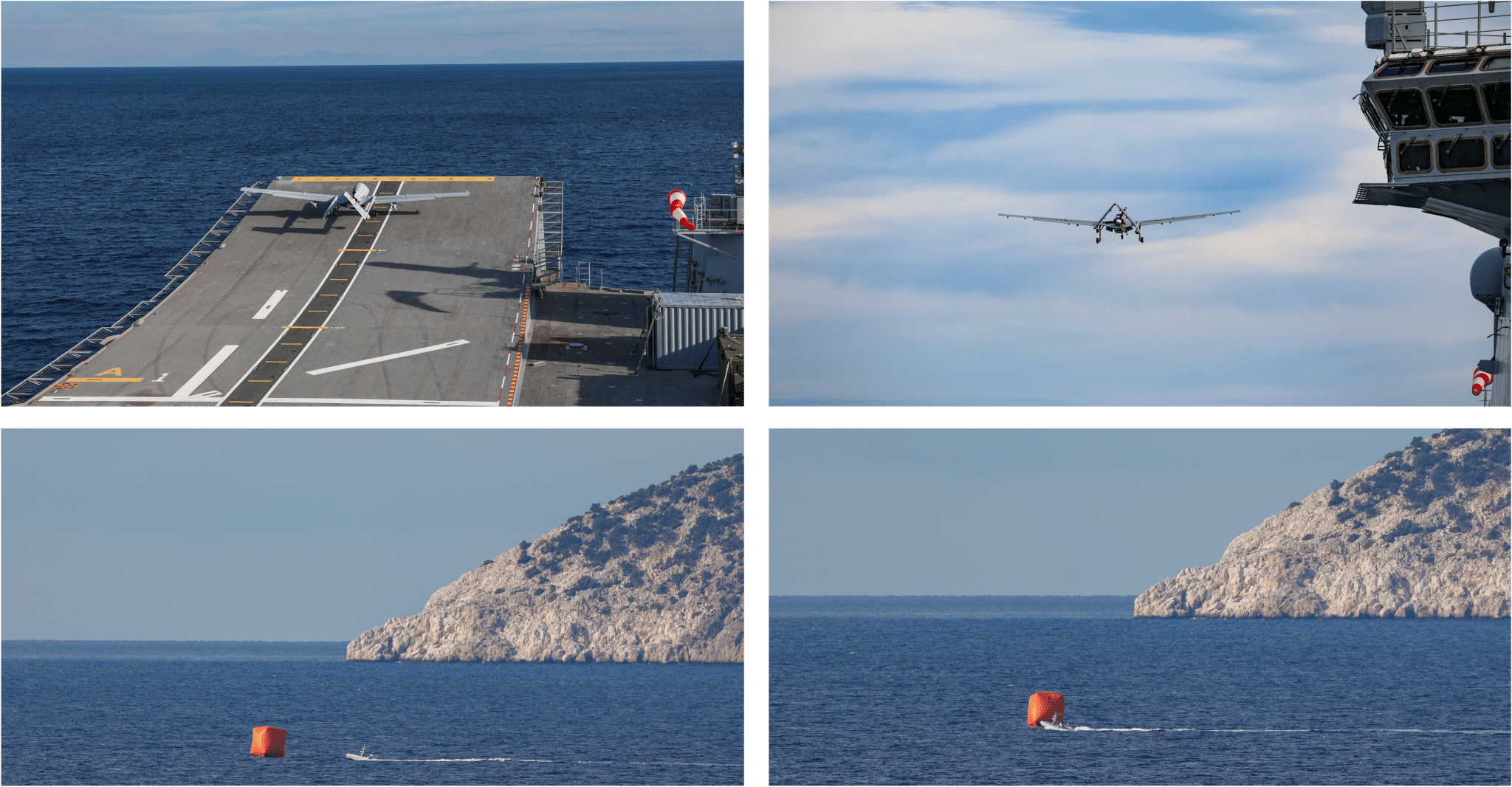
The Turkish Navy just performed a rare coordinated UxV attack involving an aerial drone and a surface drone: On 4 December 2025, an ASELSAN Albatros-S Unmanned Surface Vehicle (USV) successfully neutralized a sea target while being remotely controlled through the data link of a Bayraktar TB3 UCAV operating from TCG Anadolu in the Eastern Mediterranean.
Baykar press release
The test activities, planned in line with the operational needs of the Turkish Naval Forces and conducted from the TCG Anadolu, marked significant progress in the integration of unmanned systems. In the test carried out in the Mediterranean, Bayraktar TB3 UCAVs taking off from the deck of TCG Anadolu demonstrated both their firepower and their “joint operation” capability by commanding unmanned systems at sea. The demonstration, which featured notable moments, was also observed by military delegations from Italy, the United Kingdom, Spain, Japan, and Brazil.
The test successfully validated the hybrid operation concept in the field. Through the data link systems onboard the Bayraktar TB3 UCAV taking off from TCG Anadolu, remote control was established over the ASELSAN-produced Albatros-S Kamikaze Unmanned Surface Vehicle (USV). The USV, directed to its target via commands transmitted from the Bayraktar TB3, successfully engaged and neutralized the maritime threat.
As part of the activity carried out off the coast of Antalya, two Bayraktar TB3 UCAVs launched in salvo from the TCG Anadolu for strike missions and reached the designated area. One of the Bayraktar TB3s conducted munitions release on ground targets on the target island using the nationally developed MAM-T and MAM-L smart munitions produced by ROKETSAN, which it carried under its wings. The other Bayraktar TB3 delivered fire on the target with KEMANKEŞ-1 AI-Based Mini Cruise Missiles, developed indigenously by Baykar.
The designated targets were successfully hit during the strikes.
Following this significant test in the Blue Homeland, the Bayraktar TB3 UCAVs completed their return maneuvers. One of the Bayraktar TB3s executing the mission successfully landed back on TCG Anadolu, and subsequently took off again to transit to Keşan. The other Bayraktar TB3 participating in the test also returned to Keşan in line with mission planning.
Entering the top 10 exporters across all sectors in Türkiye in 2023 and 2024 and winning the Export Champions Award, Baykar was also the export leader of the defense and aerospace sector in 2021, 2022, 2023, and 2024, according to data from the Defense Industry Agency (SSB) and the Turkish Exporters Assembly (TIM). In 2023, Baykar alone accounted for one-third of the sector’s exports. In 2024, it single-handedly realized one-quarter of the defense and aerospace sector’s total exports, positioning Türkiye as the global leader in the UAV export market. Baykar, the world’s largest unmanned aerial vehicle company, has signed export agreements with 36 countries for the Bayraktar TB2 UCAV and with 16 countries for the Bayraktar AKINCI UCAV, totaling 37 countries to date.
– End –
Naval News comments
The demonstrated integration of UxV (unmanned air and surface platforms) marks a meaningful step in a technological field that, despite still being in its early stages, is already reshaping long-standing paradigms in naval warfare. While UAVs have played decisive roles in conflicts for more than a decade, the emergence of unmanned surface vehicles as disruptive combat tools truly gained global attention during the Russia–Ukraine war, where low-cost kamikaze USVs proved capable of disabling or destroying high-value warships. This shift has compelled navies to reassess their force-planning assumptions and has pushed industry to accelerate investments in autonomous maritime technologies. As these systems proliferate, efforts now focus not only on expanding the capabilities of unmanned platforms but also on meaningfully integrating them into manned fleet architectures.
In this context, the coordinated engagement executed by the shipborne Bayraktar TB3 and the ASELSAN Albatros-S USV represents an important leap. This form of air–sea unmanned cooperation has the potential to reduce the operational burden on manned assets, enhance mission flexibility, and significantly mitigate risk to personnel by pushing the engagement envelope farther from crewed platforms. The ability of a UAV to remotely command a kamikaze USV is particularly noteworthy, as it extends both the effective range and tactical utility of the surface drone.
More importantly, it serves as a technological demonstrator for future concepts of operation—such as UAV-directed ASW missions conducted by USVs equipped with sonar and lightweight torpedoes, airborne terminal guidance for USV-launched missiles like ÇAKIR, or coordinated electronic-attack packages executed by multiple unmanned systems.
It would be unrealistic to suggest that unmanned systems will replace manned fleets in the foreseeable future. However, considering that most navies envision hybrid fleet structures over the next two to three decades, it is clear that countries advancing rapidly in unmanned domain integration will gain a measurable advantage. Their fleets will be more flexible, more survivable, and significantly more capable of conducting distributed, risk-averse operations—ultimately redefining effectiveness in 21st-century maritime warfare.
https://www.navalnews.com/naval-new...ted-uxv-attack-during-one-of-a-kind-exercise/
Prof. Dr. Haluk Görgün:
In the Blue Homeland today, not just a test was conducted, but one of the first field examples of the future's joint operations architecture was successfully executed. The high-precision strikes carried out by our Bayraktar TB3 platforms, which took off successively from TCG ANADOLU, using MAM-T, MAM-L, and KEMANKEŞ-1 munitions, and the complete destruction of the target by the ASELSAN Albatros-S UCAV commanded via TB3, is a powerful manifestation of the maturity achieved by our defense industry. The remote command and control provided to the UCAV via Bayraktar TB3 has demonstrated the validation in the field of our hybrid operations concept and capabilities; it has announced to the world that air and sea elements can operate in an integrated manner within a single mission cycle. The successful engagement of all targets in the missions executed with MAM-T, MAM-L, and KEMANKEŞ-1 munitions has confirmed the effectiveness in the field and high accuracy capability of our national munitions ecosystem. The TB3s completing their missions after a salvo takeoff and one of them returning to Dalaman to successfully land on TCG ANADOLU is the clearest indicator of operational agility. Behind these successes lies a deep technological accumulation ranging from artificial intelligence-supported flight control algorithms to sensor fusion, autonomous maritime vehicles, and air-to-control chains. Türkiye is now resolutely advancing to a position not just as a follower in unmanned and autonomous systems, but as a country that produces doctrines and sets standards.
Last edited:
Interestingly, Baykar's assets are now being blurred on Google Maps. This is while TurAF assets remain unblurred. (I know that you can easily access non-blurred maps of these assets on other services, but still interesting.
Picture from Tekirdag.

And Kesan.

Picture from Tekirdag.
And Kesan.


