

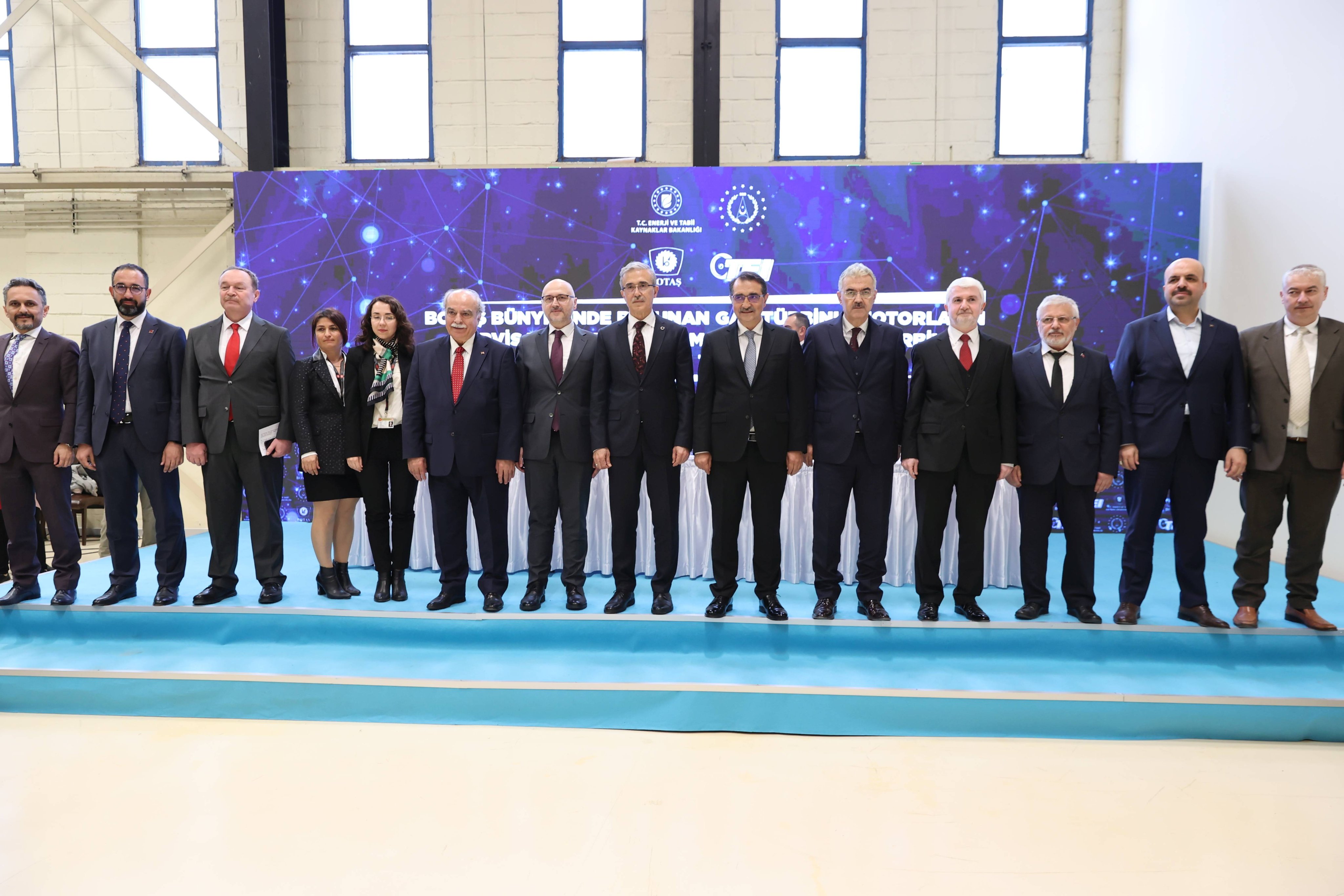
TEI will develop gas turbine for BOTAŞ


Latest Thread
Gezgin should be use turbofan not turbojet type,if you accept range is is a little short or warhead a little less with the help of reduced oil consumption may be its okey.KTJ 3700 can be fired at 10km altitute thats not for land based atmaca.


It was said that Gezgin will be turbojet, that's what the Arat project is for. I wonder if there might be a turbofan surprise from Ukraine. For long-range cruise missiles going from low altitude, turbojet does not make much sense, in terms of air density, fuel and efficiency. If it happens, it will be a turbojet out of necessity...Gezgin should be use turbofan not turbojet type,if you accept range is is a little short or warhead a little less with the help of reduced oil consumption may be its okey.KTJ 3700 can be fired at 10km altitute thats not for land based atmaca.

A turbofan will be developed to suit both later blocks of Gezgin and small drones. Guess, they are trying to assess potential application fields and feedbacks from corresponding companies for the performance criteria and developing a scalable engine.It was said that Gezgin will be turbojet, that's what the Arat project is for. I wonder if there might be a turbofan surprise from Ukraine. For long-range cruise missiles going from low altitude, turbojet does not make much sense, in terms of air density, fuel and efficiency. If it happens, it will be a turbojet out of necessity...
Damn this turbofan business, what is the SSB waiting for in terms of Turbofan technology acquisition and development?
Are they waiting for TEI to finish TF-6000? So that some of the team can go work on TF-35k and some on Gezgin TF?A turbofan will be developed to suit both later blocks of Gezgin and small drones. Guess, they are trying to assess potential application fields and feedbacks from corresponding companies for the performance criteria and developing a scalable engine.

Unless we are going to produce a cruise missile with a range in excess of 1200km, using a turbojet engine to propel the cruise missile is sufficient.It was said that Gezgin will be turbojet, that's what the Arat project is for. I wonder if there might be a turbofan surprise from Ukraine. For long-range cruise missiles going from low altitude, turbojet does not make much sense, in terms of air density, fuel and efficiency. If it happens, it will be a turbojet out of necessity...
Damn this turbofan business, what is the SSB waiting for in terms of Turbofan technology acquisition and development?
I didn't just talk about cruise missiles, I revealed a general accumulation of frustration and exasperation.Unless we are going to produce a cruise missile with a range in excess of 1200km, using a turbojet engine to propel the cruise missile is sufficient.
Turbofan engines are more expensive to manufacture, and a turbojet that is optimised for lower altitude, long distance flight (up to around 1200km) will do the job just right and more economically.
Scalp naval (MdCN) missile powered by a TR50 turbojet engine can go as far as 1400km when launched from a ship.


 .The MMU engine and the TS3000 engine are also set to long-term targets.Can we say that the TS3000 is aimed to be an equivalent engine to the T901?Acquiring a new generation coating capability for nickel-based superalloys is also among the targets.You said that Türkiye can produce 3rd generation single crystal alloys and that it can produce PW f119 equivalent with its blisk capability.If I'm not mistaken, resistance to higher temperatures than we have in hot sections is requested.What would be the advantages of this currently for MMU engine?
“The MMU engine in this program is planned as long term project”. I wonder when this article was published? Even our Mahmut Aksit had quoted a 14 year timeline for a new jet engine. But that was from day zero onwards. Having produced TS1400 and an almost completed TF6000, this time line now belongs to an ongoing process where TF35K is in the making. There is great emphasis on getting a domestic engine in to KAAN asap. To most of us this project is the one and only priority project of our engine programs.The development of ceramic matrix composite materials has also been added to the plan as a long-term goal Sayın @Yasar

It is a very important and strategic issue. Turkiye meets a very important part of its energy needs from gas cycle power plants. Moreover, the diversity of gas supply to the market will increase in the coming years. In other words, the market may enter a new growth trend close to the momentum of the early 2000s. The turbines, maintenance and upkeep of these power plants were largely dependent on Germany. In this respect, gaining independence is very important for energy security. Russia, as you know, is a gas giant. But even they have had a lot of problems in this issue.
Aeroderivative engines is also a thing where airplane turbine cores are converted to marine or power turbines. If you don't find a suitable size marine turbine you can as well convert from aero-engines.It is a very important and strategic issue. Turkiye meets a very important part of its energy needs from gas cycle power plants. Moreover, the diversity of gas supply to the market will increase in the coming years. In other words, the market may enter a new growth trend close to the momentum of the early 2000s. The turbines, maintenance and upkeep of these power plants were largely dependent on Germany. In this respect, gaining independence is very important for energy security. Russia, as you know, is a gas giant. But even they have had a lot of problems in this issue.
There are two main pillars in derivative gas turbine engines. One is gas cycle power plant turbines and the other is marine turbine engines. The fact that an official step has been taken in gas cycle power plants may indirectly mean that we may soon see a ship turbine.
I read the land engine part and in the report, they talk about 400hp bmc power engine be ready in early 2023 as in the future which we have already saw it. Sounded like the report was done in 2021.“The MMU engine in this program is planned as long term project”. I wonder when this article was published? Even our Mahmut Aksit had quoted a 14 year timeline for a new jet engine. But that was from day zero onwards. Having produced TS1400 and an almost completed TF6000, this time line now belongs to an ongoing process where TF35K is in the making. There is great emphasis on getting a domestic engine in to KAAN asap. To most of us this project is the one and only priority project of our engine programs.
Use of Ceramic Matrix Composites in TF35K is a little presumptuous at this stage. Even though GE, TEI’s partner has been developing this technology and commercialising it by using it in civilian “Leap” class turbofan engines, until the technology becomes available to TEI, it is a bit early to think that TEI will produce engines that contain this tech. But TEI is most likely in the process of investigating of adapting this tech in to their future engines.
There could still be a time in near future where TEI can take out a rabbit out of the hat like they did with the single crystal blades.
T901 is still under development. Yes, in this report the TS3000 has been planned as a long term goal. But in view of Ukrainian engine being underpowered for what we expect from ATAK-2 , the TS3000 should really be in medium term list at least. But going forward the goal could be a T901 class engine for ATAK-2.
Today Turkey can produce 3rd generation single crystal blades. These are the most common blades that are produced to achieve the demands of most modern jet engines in the west. However if you check the IHI XF9 engine , you will see that they used 5th generation single crystals in the turbines. Not just that, but they also friction welded these blades to the turbine base, effectively creating a “Blisk” turbine section.
So there is nothing to stop what TEI can do when it comes to engine development. But instead of achieving esoteric goals in high tech, I would like to see an operational, stealthy 24-26000lbf dry thrust turbofan that we have manufactured ourselves before anything else.
It is true that the higher the air temperature at turbine entry, the more efficient and more powerful the engine is. At the end of the day when you throw out more energy out of the nozzles you get more thrust. So more heat means more energy that means more thrust. But it is also possible to obtain high efficiency with incremental improvements and with new technologies such as Blisk usage in compressors. Mr Aksit when claiming to have capability to produce an engine like F119 was not exaggerating. With 3rd generation single crystals he knew he could get the turbine entry air temperature high enough to develop the required thrust level. He also knew that by adopting blisk technologies he could squeeze even more juice out of that engine.
Now proof of the pudding is in the eating. He has to put what he said in to practice.
TÜBİTAK SAGE Director Gürcan Okumuş:
- In addition, another technology as important as RAMJETs, the Continuous Cyclic Detonation Engine (CCDI) Technologies Development Project is also being carried out within SAGE. This is a "game changer" engine technology, and alternatives for its use not only in space systems but also in missile systems are being studied.

TÜBİTAK-SAGE | Söyleşi/2: TÜBİTAK-SAGE Enstitü Müdürü Gürcan Okumuş
TÜBİTAK-SAGE Müdürü Gürcan Okumuş ile TÜBİTAK-SAGE’nin devam eden projeleri ve gelecek vizyonu üzerine söyleşi gerçekleştirdik. Keyifli okumalar dileriz. 1.Soru |mavivatan.net
I wish Gürcan Bey would explain why they developed a liquid fuel ramjet instead of solid fuel.Can someone who knows answer me. Can the solid-fuel ramjet engine developed by Roketsan for Akbaba be used in an air-to-air missile?TÜBİTAK SAGE Director Gürcan Okumuş:
- Development work on Ramjet and Scramjet Propulsion Systems within TÜBİTAK-SAGE continues at full speed. We have already brought Ramjet technology to a certain point, and we have already started to use it in existing projects. Scramjet, as you know, is a much more challenging technology. We continue to develop the technology with the laboratory-scale tests we are conducting at TÜBİTAK SAGE.
- Many studies on the development of liquid-fueled ramjet engines using our already established test infrastructures have been carried out within TÜBİTAK-SAGE. The point we have reached in a short period of time within the scope of the SYRJ project we are conducting has encouraged us to become one of the leading countries in the world in liquid-fueled engine and scramjet engine technologies in the advanced stage.
- On the one hand, we continue to work on the development of existing infrastructures, while on the other hand, we continue our efforts to establish an infrastructure where we can carry out ramjet engine tests and aerodynamic warm-up tests. In this context, the TAYFUN Aeroitki Test Infrastructure is being established and the development of the Trisonic Wind Tunnel infrastructure is ongoing. The TAYFUN Aeroitki Test Infrastructure will contribute to supersonic and, in the future, hypersonic studies.
- In addition, another technology as important as RAMJETs, the Continuous Cyclic Detonation Engine (CCDI) Technologies Development Project is also being carried out within SAGE. This is a "game changer" engine technology, and alternatives for its use not only in space systems but also in missile systems are being studied.
TÜBİTAK-SAGE | Söyleşi/2: TÜBİTAK-SAGE Enstitü Müdürü Gürcan Okumuş
TÜBİTAK-SAGE Müdürü Gürcan Okumuş ile TÜBİTAK-SAGE’nin devam eden projeleri ve gelecek vizyonu üzerine söyleşi gerçekleştirdik. Keyifli okumalar dileriz. 1.Soru |

I wish Gürcan Bey would explain why they developed a liquid fuel ramjet instead of solid fuel.Can someone who knows answer me.
Can the solid-fuel ramjet engine developed by Roketsan for Akbaba be used in an air-to-air.


