
• Forum restore complete (see latest announcement thread)

TR UAV/UCAV Programs | Anka - series | Kızılelma | TB - series

Sanchez

Experienced member
Moderator
Think Tank Analyst
DefenceHub Diplomat
Messages
4,181
Reactions
125 19,013
Nation of residence
Turkey
Nation of origin
Turkey

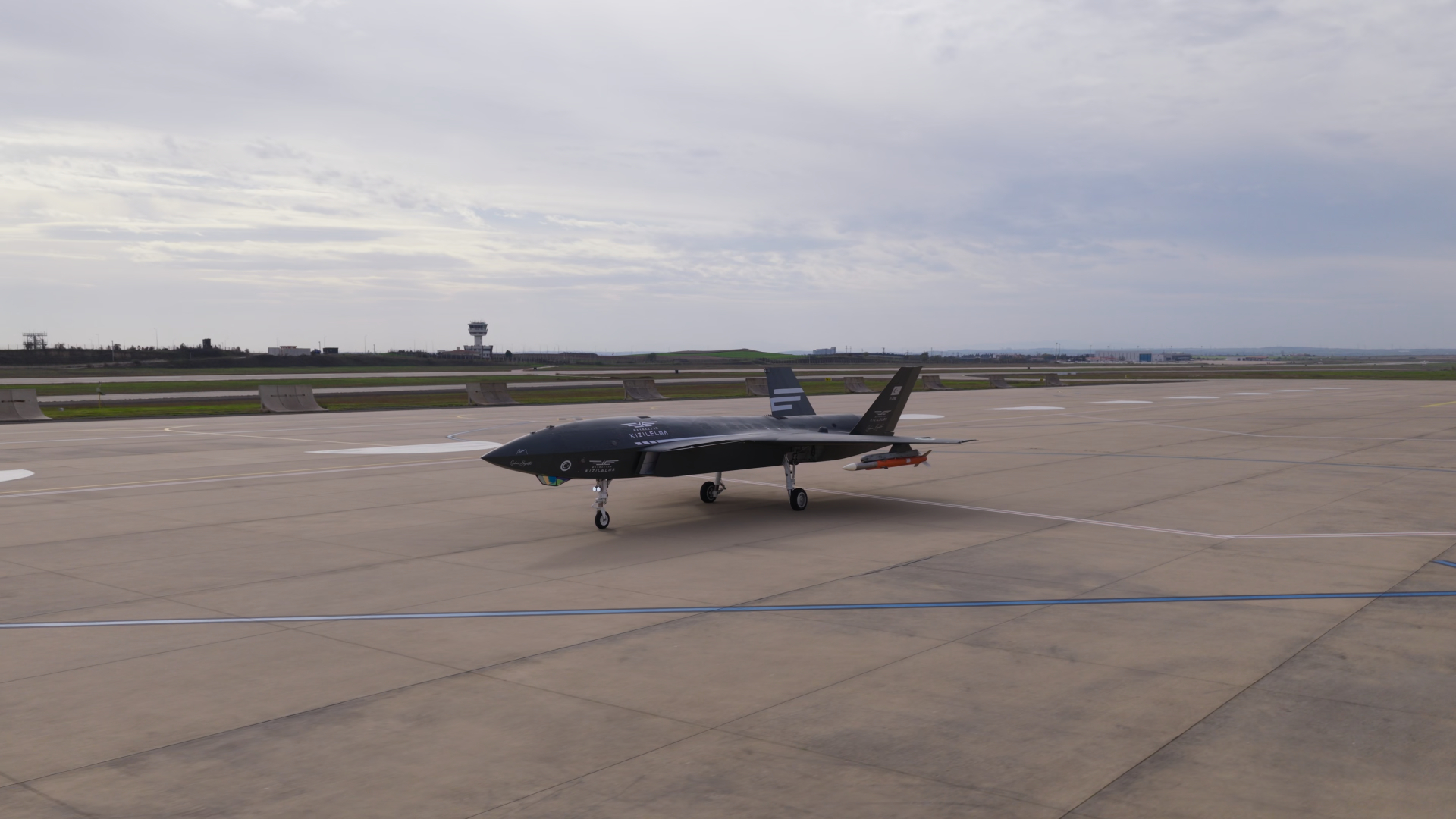
HISTORIC TRIAL FOR BAYRAKTAR KIZILELMA: LOCKED ONTO AN F-16, SCORED A DIRECT HIT IN SIMULATED FIRE!​


Türkiye’s first unmanned fighter aircraft, Bayraktar KIZILELMA, has carried out yet another historic test in the sky. In the test conducted with the participation of two F-16 fighter jets of the Turkish Air Force, KIZILELMA locked onto the target F-16 using the national AESA Radar MURAD, and achieved a direct hit in its simulated fire test with the national air-to-air missile GÖKDOĞAN.​


Taking off from the AKINCI Flight Training and Test Center in Çorlu, Tekirdağ, the national unmanned fighter aircraft carried out formation flying with the F-16s and validated the integration of the national radar and munitions during its 1-hour-45-minute flight at an average altitude of 15,000 feet. With this flight, Bayraktar KIZILELMA’s total test flight time has surpassed 55 hours.

Two F-16 fighter jets belonging to the Turkish Air Force participated in the “Bayraktar KIZILELMA – GÖKDOĞAN Armed Flight and MURAD AESA Radar Performance Test.” One of the F-16s performed close formation flying with Bayraktar KIZILELMA, demonstrating the platform’s compatibility with manned fighter aircraft, while the other F-16 acted as the “target aircraft” within the test scenario. During the test, Bayraktar KIZILELMA detected the target F-16 at a distance of 30 miles using the MURAD AESA Radar developed by ASELSAN and locked onto the target. It then executed a simulated electronic firing using the GÖKDOĞAN Beyond-Visual-Range Air-to-Air Missile produced by TÜBİTAK SAGE and carried under its wing. In the simulation, Bayraktar KIZILELMA successfully neutralized the highly maneuverable F-16 target with a virtual direct hit, marking a major step forward for air-to-air combat capability.

One of the most critical phases of the test involved evaluating the communication infrastructure between the aircraft, radar, and missile. After locking onto the target F-16, Bayraktar KIZILELMA transmitted real-time target, position, and velocity data obtained from the MURAD AESA Radar seamlessly to the GÖKDOĞAN missile carried under its wing. The successful validation of this data link between Bayraktar KIZILELMA and the munition represents a significant milestone in the unmanned fighter aircraft’s capability to neutralize beyond-visual-range (BVR) targets.

During this historic flight over the skies of Tekirdağ, three distinct and challenging test scenarios were executed simultaneously with success. The F-16 formation flight—which demonstrated the capability for joint operations with manned fighter aircraft—offered insights into future air-combat concepts. The aerodynamic and avionic compatibility of the platform was verified through the GÖKDOĞAN Beyond-Visual-Range Air-to-Air Missile carried under the wing. In the same flight, the detection, tracking, lock-on, and data-transfer capabilities of the national MURAD AESA Radar—which was activated for the test—were also proven under demanding conditions.
 

Yasar_TR

Experienced member
Staff member
Administrator
Messages
4,270
Reactions
258 22,300
Nation of residence
United Kingdom
Nation of origin
Turkey
What has been occupying me for a long time with Baykar regarding engine construction is how they imagine building an engine from scratch without experience and know-how. Also, they have set the measuring plate very high: a jet engine with an afterburner. The whole thing seems very, very questionable to me. What comes to mind: they are up to something we don’t know, or they have acquired quite a bit from the Ukrainians (engineering, technical knowledge, etc.) with money.

A jet engine with an afterburner... requires a hell of a lot. Even upgrading the TF6000 to the TF10000 involves a great deal of knowledge and work. Things are not as simple as in YouTube videos.
I fully agree with everything you say. Turbofan engine is one of the hardest technologies one can acquire. If you are building a 6000/10000lbf dry/wet thrust engine you are probably at the first steps. If you are envisaging building a 12000/20000lbf dry/wet thrust engine, then you are half way up the steps as achievement goes. If you are aiming to build a 20000/30000lbf dry/wet engine then you are aiming for the pinnacle of turbofans.

The bigger the diameter and the higher the thrust level gets, then the more difficult it becomes to achieve success. This has a lot to do with engineering and material science requirements of bigger engines. It is a fact that an average and optimistic 10year time period that you have to allow yourself to achieve your goal when building a new and “modern” turbofan with all the bells and whistles is normal.

Baykar is aiming for a 12000/20000lbf dry/wet turbofan engine. To do justice to a stealthy jet like KE, they need an engine that is stealthy too (like tf6000) with modern technologies like blisks applied to that engine.

Ukranian engines were produced with almost obsolete Soviet technology that did not even have single crystal turbine blades. Also the Motor Sich factory that manufactured their engines never built any fighter jet engines more than 6000/10000lbf dry/wet thrust. To expect anything more from that factory or it’s broken up/leftover staff, is being far too optimistic.

If you give the job to a reputable engine manufacturer to build engines for you to your own specifications, then they become prohibitively expensive. (Israel’s F124 Honeywell engines or UAE’s F110GE132 engines). So logical route for the sort out quantities Baykar will need, will have to be engines produced in house or make use of TEI facilities.
Even though Piaggio manufactures engine parts for large engine manufacturers, to be able to manufacture a complete turbofan is a different thing altogether.

Selcuk Bayraktar is a clever guy. He knows everything that is said here. To come up and say that they are going to have an engine in 5-6 years is either a publicity stunt or they have a factory stashed up somewhere no one knows about. Or he is going to use TEI facilities to develop something after TF10000.
His best bet would be to build a twin engined version of KE with twin TF10000 engines.
 

OPTIMUS

Committed member
Messages
260
Reactions
2 593
Nation of residence
Germany
Nation of origin
Turkey
Moreover, if KALE itself admits that it took them 10 years to be able to deliver the TJ Series....

The collaboration with BAYKAR/PIAGGIO does not include technology transfer. Often it was about Baykar being SAFE.

SAFE from the dangers of a power change in Turkey; SAFE to secure European orders as a European company.
 
T

TR_123456

Guest
What has been occupying me for a long time with Baykar regarding engine construction is how they imagine building an engine from scratch without experience and know-how. Also, they have set the measuring plate very high: a jet engine with an afterburner. The whole thing seems very, very questionable to me. What comes to mind: they are up to something we don’t know, or they have acquired quite a bit from the Ukrainians (engineering, technical knowledge, etc.) with money.

A jet engine with an afterburner... requires a hell of a lot. Even upgrading the TF6000 to the TF10000 involves a great deal of knowledge and work. Things are not as simple as in YouTube videos.
They could have gotten the TF6000 blueprints and papers/notes of the work on the TF10000 from TEI brand it as inhouse development and give it a new name.
TEI is busy on the TF10000,no?
 

boredaf

Experienced member
Messages
2,265
Solutions
1
Reactions
42 6,641
Nation of residence
United Kingdom
Nation of origin
Turkey
Lads, can we be realistic for a second, instead of blindly optimistic?

At the moment, there are exactly 2 countries on the planet that has 5th generation jet engines. One of them, China, has only just recently started its serial production, despite having decades of building jet engines and having the chance to get "inspiration" from US. And US, achieved that after decades and billions. Russia has just shown their engine in public but I don't think they have flown it yet, Rolls Royce made a demonstrator for F-35 project as far as I can remember. And TEI has just started TF6K, working on TF10K and possibly in advanced design process of TF35K.

All of these countries and companies either have extensive history and experience in the field, none of them including TEI suddenly jumped to 5th gen. I find the idea that Baykar can suddenly make a 5th gen 20k thrust in a timescale that would make it relevant to our urgent needs is utterly ridiculous. I'm sure people are going to disagree and I expect to get the usual "angry" rating from the same people, but even if they manage to poach some talent from other companies, which is not a given AT ALL, it would take insane amount of time to design, master all the necessary techniques to built one and test it. And not to mention creating all of that infrastructure and talent would take billions and billions, far more than Baykar has ever spent OR made.

Third iteration of KE was revealed as a two engine one at the time, it is far more reasonable to keep to that plan with dual TF10Ks than to expect a miracle of engineering and aviation.
 

OPTIMUS

Committed member
Messages
260
Reactions
2 593
Nation of residence
Germany
Nation of origin
Turkey
Yes,officially they do.
It's really a shame!!

BAYKAR does not want and must not provide an open target for certain political parties.

But ultimately, this makes BAYKAR products more expensive abroad. Baykar recoups all expenses through sales.

In other countries, many things are made available for such tests for free. Like the German Air Force back then provided their F-104 for free. Or in the USA, the Navy makes many things available for the film industry for free. Or again in Germany, when the FRONHOF Institute wants to conduct tests, we provide fire department, police, and THW support.

For BAYKAR, something like that is unfortunately suicide. If you consider that its own companies were boycotted in their own country.

If Turkish BAYKAR products become more expensive as a result, we also need to know who benefits from that. Just think about it.
 
T

TR_123456

Guest
It's really a shame!!

BAYKAR does not want and must not provide an open target for certain political parties.

But ultimately, this makes BAYKAR products more expensive abroad. Baykar recoups all expenses through sales.

In other countries, many things are made available for such tests for free. Like the German Air Force back then provided their F-104 for free. Or in the USA, the Navy makes many things available for the film industry for free. Or again in Germany, when the FRONHOF Institute wants to conduct tests, we provide fire department, police, and THW support.

For BAYKAR, something like that is unfortunately suicide. If you consider that its own companies were boycotted in their own country.

If Turkish BAYKAR products become more expensive as a result, we also need to know who benefits from that. Just think about it.
It doesnt matter how it is,it will always be seen as favorism.
Lets be realists here,there is no Baykar product better then what TAI produces.
Baykar is good for export,thats all.
 

OPTIMUS

Committed member
Messages
260
Reactions
2 593
Nation of residence
Germany
Nation of origin
Turkey
In Turkey, this comparison between BAYKAR and TAI comes up very often. It's like comparing apples and oranges. BAYKAR, of course, has to be good for export, but the same goes for everyone else. That’s the alpha and omega for the success of any company. Years ago, I read an analysis of ASELSAN, I believe it was by Arda M. At that time, ASELSAN was declared dead because this company received a very high share of its orders domestically. Since then, ASELSAN has expanded internationally and is achieving success stories. And BAYKAR's products aren't bad either. In the end, they have driven many competitors out of the market. That doesn’t happen with poor products. TAI's products are better… etc., these are claims without facts.


For example, AKSUNGUR... I still can't believe that such a poor product came from a company that used to assemble and partly produce the F-16.

Admittedly, BAYKAR, like all privately operated companies worldwide, benefits from certain advantages. However, these advantages come from freedom of movement in gray areas and agility in decision-making. TAI can't do that.

Gentlemen, I have followed all the production work on ANKA. TAI had such a difficult birth, you wouldn't believe it. How many times the wing designs were changed, how many times the outer skin was made thinner, how many times, how many times, how many times... and they did the same with HÜRKUS and HÜRJET. Thank God HÜRJET is now an EU product, so TAI can no longer change anything.


As far as state aid is concerned, the Turkish president personally intervened for TAI in some African countries, resulting in one being purchased for HÜRKUS.
 
Last edited:

OPTIMUS

Committed member
Messages
260
Reactions
2 593
Nation of residence
Germany
Nation of origin
Turkey
I could spend an hour at the computer writing about how TAI has been favored by the Turkish state in unmanned systems since 1997 and has enjoyed all the advantages.

Even TAI received aid from PAKISTAN for the ANKA project so that the bird would get proper wings. The events that happened in the ANKA project are enough for a Hollywood movie.

That’s why no one should say here that BAYKAR is being favored. Another company would have long since left the country and never come back.
 
Last edited:

Yasar_TR

Experienced member
Staff member
Administrator
Messages
4,270
Reactions
258 22,300
Nation of residence
United Kingdom
Nation of origin
Turkey
Akinci is a platform that definitely outperforms TAI's drone in all areas; Aksungur cannot compete with it.
TAI is state owned,it can go slow.
Baykar is not,it needs to earn to develop.
We mustn’t compare apples with oranges.
TAI is a state owned company with certain bureaucratic practices that can not be overcome easily. That makes it lethargic and not malleable like a private sector company as Baykar.

There is a fine and sensitive division of work share between the two companies when it comes to UAVs.

Small lightweight UCAVs are produced by Baykar. (TB2 & TB3)
Supersonic Stealth attack UCAVs are produced by Baykar. (KE)
High altitude turboprop UAVs are also Baykar’s domain. (Akinci)

Heavier weight mid altitude long endurance UAVs are produced by TAI (Anka-1 and Anka-2-Aksungur)
Subsonic deep strike flying wing stealth UCAVs are produced by TAI (Anka-3)

You can not compare Aksungur with Akinci. One is powered by internal combustion diesel engine, the other by a high powered turboprop. There is a version of Akinci with twin TEI-PD170 engines. It’s performance is not great, apart from it’s longer endurance. Akinci comes to its own especially with the twin 850HP turboprops.
 

IC3M@N FX

Contributor
Messages
700
Reactions
3 30 1,432
Nation of residence
Germany
Nation of origin
Turkey
I don't fully understand the specific benefits of the Aksungur drone. It seems like a platform that is uncompromisingly optimised for endurance, but without offering a payload capacity or system diversity that even comes close to the level of the Akinci.

In my view, it would have made more strategic sense for TAI to develop a smaller "Global Hawk-class" drone – that is, a dedicated high-performance reconnaissance and espionage UAV optimised exclusively for ISR missions. With AI-322F engines and later a conversion to TEI-TF6000 or TF10000, it would have been possible to create a true high-altitude and high-speed platform.

Currently, there are many Turkish combat drones that can also perform reconnaissance tasks, but not a single platform designed purely for strategic ISR. Perhaps the Anka-S comes closest to this approach; it has been chosen very often for such missions, but even it does not achieve the flight altitude or speed of a turbofan-powered HALE system.
Akinci, on the other hand, is too large and not optimised for covert missions.

I also do not see the Anka-3 as a sole replacement for a true strategic reconnaissance platform – unless the design is made so modular that it can also be used as a pure stealth ISR UAV in the future.

However, a compact Global Hawk equivalent would be ideal.
 

begturan

Well-known member
Messages
346
Reactions
4 633
Nation of residence
Turkey
Nation of origin
Turkey
When I look at the comments made, I see that it is impossible for Baykar Motor to develop a 20,000 lb engine, the possibility that they are working on 2xTF10000 is reasonable in the medium/short term. Logically, even if this Baykar engine gets technical support from sich and TEI, it is futile to expect it to run before it can crawl and walk.

Two 10,000 lb engines will provide an extra payload, more fuel, and greater maneuverability. The aircraft will accelerate from subsonic to hypersonic speeds, achieving faster climb, better maneuverability, and higher altitude.

This will give Kızılelma deeper capabilities in its operations with Kaan, especially in terms of range, and will significantly reduce Kaan's workload. More options in flexible payload decoy/logistics/munition/EW combinations.
 

Merzifonlu

Contributor
Think Tank Analyst
DefenceHub Diplomat
Messages
814
Reactions
28 2,496
Nation of residence
Turkey
Nation of origin
Turkey
I’m curious about something that hasn’t come up in this discussion. Baykar CEO Haluk Bayraktar said, “We will also produce the engine of Kızılelma,” but he didn’t say, “We will develop and produce the engine of Kızılelma.” Am I misremembering? Can someone confirm?

If it’s just about production, they could potentially manufacture the TF-10000 engine themselves under a license from TEI. And if the SSB covered the development costs for the TF-10000, they might be able to produce it directly.
 

Yasar_TR

Experienced member
Staff member
Administrator
Messages
4,270
Reactions
258 22,300
Nation of residence
United Kingdom
Nation of origin
Turkey
I’m curious about something that hasn’t come up in this discussion. Baykar CEO Haluk Bayraktar said, “We will also produce the engine of Kızılelma,” but he didn’t say, “We will develop and produce the engine of Kızılelma.” Am I misremembering? Can someone confirm?

If it’s just about production, they could potentially manufacture the TF-10000 engine themselves under a license from TEI. And if the SSB covered the development costs for the TF-10000, they might be able to produce it directly.
According to the 2024 interview notes below he is vague about the engine production of Baykar.


He says they have decided to allocate 300 million dollars to engine development of Akinci and KE. But in another media notes he says that includes the 200+ TB2 engines they intend to produce every year in house. This engine is a small internal combustion engine that will replace the Rotax they are currently using for the TB2s.

Then he says the engine of KE will be ready and be an indigenous one within 4 years. He does not specifically say Baykar will be producing it.
We all know to develop and produce a turbofan like TF6000/10000 will take at least 10 years and will cost a lot more than that 300 million.
It means that the ongoing programme with current Ukranian engine propelling KE, will be indigenised by replacing it with TF10000.
The TF6000 is a capable engine too and will most likely suffice for KE. But if we want it to carry more payload at take off and be able to go supersonic when required, then TF10000 is the right choice.
 

Follow us on social media

Top Bottom