

Gökhan is ramjet and it will possibly be fired from Kızılelma. I am not sure what speed is needed to start a ramjet engine but Kızılelma will go supersonic when it gets a better engine.Can the Kizilelma fire hypersonic missiles?

You are using an out of date browser. It may not display this or other websites correctly.
You should upgrade or use an alternative browser.
You should upgrade or use an alternative browser.
Kaan will hopefully cover alot of bases and TUSAŞ can turn to cargo and passenger planes for a period of time while a 6th gen plane will go on a backburner until time is ripe to make one. Anka4 is probably meant to be an unmanned version of a 6th gen plane so backburner for a decade or so.


We are all discussing on conjectures over an idea that was thrown in few years ago by Temel Kotil. He said something along the lines of “there would be Anka 4 to come yet. There will be a supersonic version.” looking at Anka-3.
Since then everyone has been guessing what this Anka-4 can be. There is no statement from Tusas regarding an Anka-4.
For one thing , if it is going to be a flying wing like Anka-3, It is not feasible for it to be supersonic. If it is going to be supersonic, then it will be in a more conventional design. Not a flying wing. We don’t even know if there is work being carried out on an “Anka-4”.
But if it is going to be built by Tusas, you can be sure that it will be built to a very high standard and will be a game changer class platform.
I agree with @Pilatino to have an expendable UCAV with long enough range to play both loyal wingman role and at the same time be able to penetrate deep in to enemy airspace and play the role of a kamikaze UAV. But süper Simsek is almost there. It can be carried along, under the wing of Anka-3, and when close enough, released to allow Anka-3 to return to full stealth mode whilst being stealthy itself, it can travel together to have suddenly two stealth UCAVs instead of just one attacking enemy positions.
Şüper Şimşek as Loyal Wingman > Kızılelma > Anka 4 would work for me.
TUSAŞ is very busy but I hope they can show us a capable Süper Şimşek and Anka 4 on spotlight at least in IDEF27'. That would end all my worries.
just for the sake of a better understanding and conceptualizing your ''Loyal Wingman'' What roles does a Loyal Wingman should perform and what capabilities does it have to have to be considered as a Loyal Wingman according to You? also would be intersting to hear the opinions of others as well
Last edited:

Great question. For me, a Loyal Wingman isn’t defined by a single platform but by the roles and capabilities it must reliably deliver. In my view, a system qualifies as a Loyal Wingman if it can perform the following:just for the sake of a better understanding and conceptualizing your ''Loyal Wingman'' What roles does a Loyal Wingman should perform and what capabilities does it have to have to be considered as a Loyal Wingman according to You?
1. Risk-tolerant mission execution
It must be expendable enough to take the high-risk tasks that manned fighters or high-value UCAVs (like Kızılelma) shouldn’t.
2. Modular payload flexibility
The platform should be able to switch between sensors, EW payloads, decoy packs, or A2A/A2G weapons depending on the mission—Gambit-style modularity.
3. Autonomous teaming with manned or unmanned aircraft
It has to operate semi-autonomously alongside a parent aircraft, receive directives, and adapt to changing battlefield conditions.
4. Tactical roles such as:
Forward sensing / ISR
Electronic attack or jamming
Decoy / signature inflation
SEAD/DEAD support
Limited A2A interception
Saturation or distraction attacks
5. Lower cost and acceptable attrition
A Loyal Wingman must be strategically “expendable”—not a platform whose loss is operationally painful.
So whether it’s Süper Şimşek, Kızılelma, or a future Anka-4 derivative, the name matters less than these core characteristics. If a system fulfills them, I’d call it a Loyal Wingman.
Kızılelma can have several versions from cheap to top notch. While its canards design is not top stealthy as well as its tail fins a stealthier plane may not be actually worth the effort if the latest radars will probably get to see even the stealthier planes better and better.
I agree that with all my heart. We need cheap (3-5 million $), no expensive or difficult to produce sensors and somewhat expandable/attritable drone. It has to be cheap, that is the key for so it can be produced at industrial scale. Also capable enough to can not be ignored, lets say "trouble makers" for enemy aircrafts and their drones.My main point is: WE NEED A "LOYAL WINGMAN" like system between Süper Şimşek and Kızılelma. The rest is unimportant tbh.
We have reached such a level in drone technology and know how, the only thing we need someone with authority that determine the requirements and say "go ahead and do it" to our companies.

Thanks but that exactly the same definition as I gave. I never said anything of number of nodes jumps to reach an endpoint. For the discussion at hand, it is typically just one node jump, namely the sattelite between drone and ground control. It could obviously be more nodes, for example more sattelites or even other drones if you relay the signal around the world.According to GCSE Physics and Computer Science specifications,
signal latency is defined as the time delay between a signal being sent from one point (e.g., a transmitter) and when it is received at another point (e.g., a receiver).
Most times a signal may hop several times to reach its destination, especially if the destination is on the other side of earth.
Signal latency in physics is not specific to a single "hop" (a single segment of a journey) but is a cumulative measurement over the entire path the signal travels. The total latency of a signal is the sum of the delays incurred at each stage of its journey.
What seem to be the issue is not the definition of latency but reaction time to an incoming sudden threat. Here it could easily be up to 2 seconds as explained when you have a human in the loop. This is barely usable for close combat as I have expressed.
I think we all agree on the subject so this will be my last reply.


A "Loyal Wingman" drone is an autonomous or semi autonomous drone designed to fly alongside and support a manned aircraft, therby acting as a force multiplier.just for the sake of a better understanding and conceptualizing your ''Loyal Wingman'' What roles does a Loyal Wingman should perform and what capabilities does it have to have to be considered as a Loyal Wingman according to You? also would be intersting to hear the opinions of others as well
It has basic responsibilities:
Manned and unmanned teaming - MUMT
Advanced AI application and thus, autonomy capability
Versatile payload if and when needed
Force multiplier by adding to the capabilities of the manned aircraft.
Decoy and distraction by imitating a manned platform.
Stealth capability to infiltrate deep in to enemy territory.
As well as adding to the capabilities of the manned aircraft, a loyal wingman is ready to sacrifice itself to save the primary platform.
KE could partially fill that position too. KE doesn’t have the necessary power to fully utilise the capabilities of the Murad Aesa radar. But can easily act as a munition mule whose guided missiles can be directed by another platform.

The more Turkiye develops the more depressed and disappointed these guys seem to be. They seem to be less and less excited by it all. In the early videos they used to laugh a lot when talking about Turkish develops, used to softly mock a lot. Now the deep breaths of frustration seem to be ever prevalent.


The more Turkiye develops the more depressed and disappointed these guys seem to be. They seem to be less and less excited by it all. In the early videos they used to laugh a lot when talking about Turkish develops, used to softly mock a lot. Now the deep breaths of frustration seem to be ever prevalent.
The assessments here must be viewed in a differentiated manner. The analysts' reluctance stems primarily from the fact that they lack clear technical verification as to whether the missile was actually guided exclusively by the drone's on-board radar or whether a handover may have taken place via an F-16 or AWACS aircraft in the vicinity. They did not express this doubt openly, but hinted at it between the lines. This is typical of sceptical observers who are not familiar with the Turkish defence industry in detail.
Like many European analysts, they continue to assume that Turkey is a very capable industrial workbench, but has only limited capacity for truly independent development and deployment of complex weapon systems. However, it is precisely this assumption that has been noticeably shaken here. They themselves have acknowledged that this is an extraordinary technological step.
It is understandable that this does not result in effusive praise for the Turkish defence industry: there is simply no emotional or national identification with the country. If the US were to present the NGAD programme in a similar way tomorrow with something completely new, people would also be impressed and would recognise the achievement – but without resorting to jubilant reports. This sober assessment is ultimately normal.


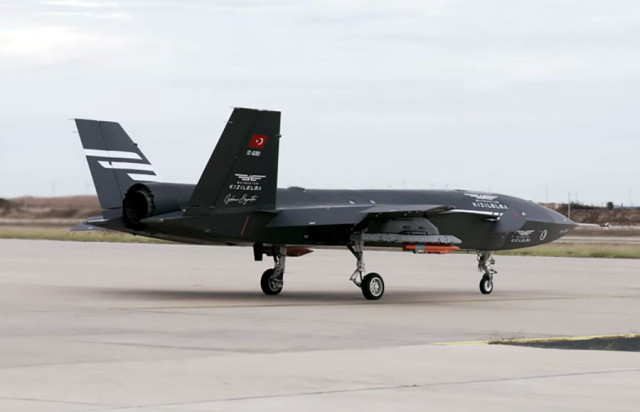
Where do you see the lens? also, the rear landing gear is not covered (should increase the RCS quite a bit).
external BVR missile doest help as well but.... test flights.... please look on the right side of the vertical stabilizer on top of the right wingWhere do you see the lens? also, the rear landing gear is not covered (should increase the RCS quite a bit).
Last edited:
YusufKnight
Member


✈️ #BayraktarTB3 ⚓️ TCG ANADOLU 🚤 ALBATROS-S 🛫 Bayraktar TB3 Üzerinden KİDA Kontrol Testi 🛫 KUSV Control Test via Bayra…
Selçuk Bayraktar - NSosyal
 sosyal.teknofest.app
More TB3 action from TCG Anadolu. Take-off with heavier and heavier payloads!
The TB-3 has given this vessel the much sought self defence and assault capability that it really was partly lacking due to the navy not heaving enough navalised helicopters. The second hand AH-1W attack helicopters taken from the army are so old (nearly 40 years) that they should really be retired. There aren’t enough Seahawks to support this ship and all the other frigates and corvettes we keep building.✈️ #BayraktarTB3 ⚓️ TCG ANADOLU 🚤 ALBATROS-S 🛫 Bayraktar TB3 Üzerinden KİDA Kontrol Testi 🛫 KUSV Control Test via Bayra…
Selçuk Bayraktar - NSosyal
More TB3 action from TCG Anadolu. Take-off with heavier and heavier payloads!
But the TB3 can perform many of the lighter missions of a Seahawk and takes the burden off of it, when it comes to self defence and surface attack. It can be airborne for much longer periods to give intelligence and defensive cover.
If only KE could land on this boat too. Then as a light version of KE, it would give a partial fighter-aircraft cover and assault capability to this ship.
But they need arrester wires fitted to Anadolu, for that to happen.
I wouldn’t be very happy if Leonardo and Baykar manage to do that on the Italian carrier Cavour and LHD Trieste before us.
Cavour
Trieste
‘
Last edited:
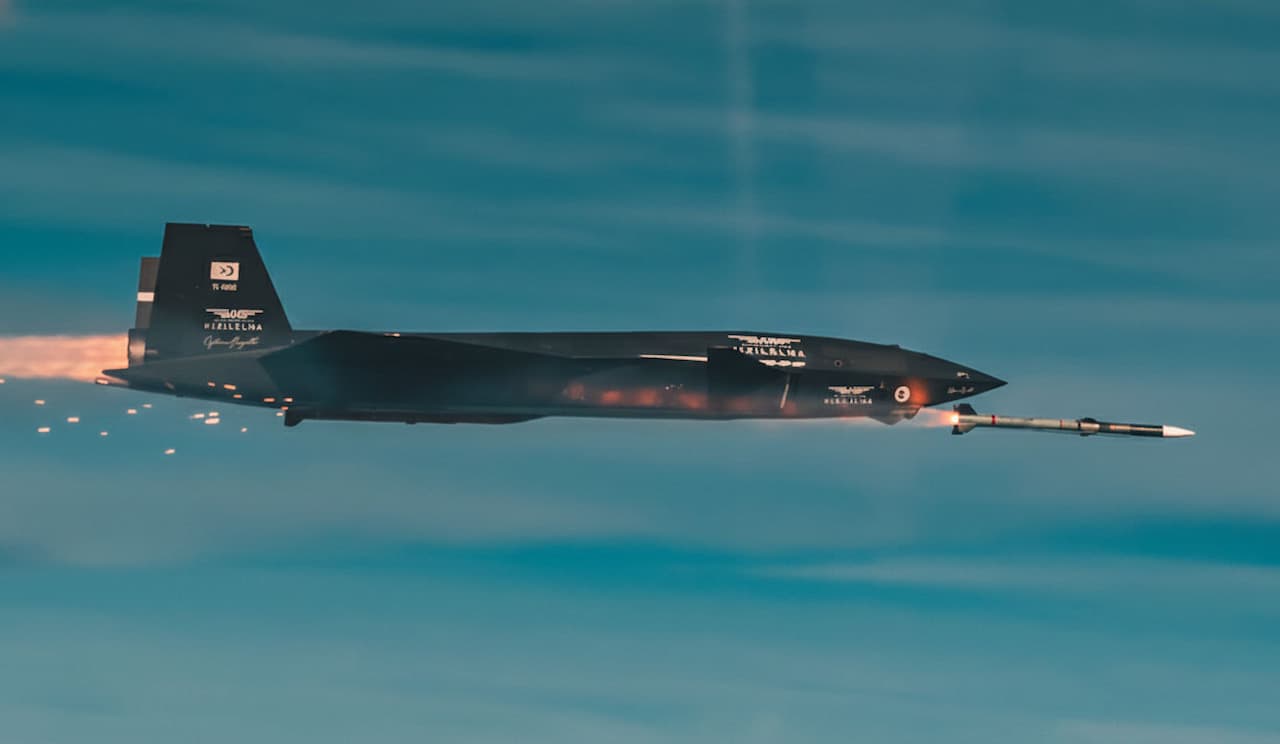
Here is what I found about Kızılelma live fire test in Japanese, I am sure there are more coverage,
 milirepo.jp
On November 30, 2025, Turkey's leading defense company, Baykar, announced that its unmanned combat air vehicle (UCAV), Bayraktar KIZILELMA, successfully conducted a groundbreaking air-to-air missile test at a firing range off the coast of Sinop on the Black Sea coast. The test marked a significant milestone in aviation and military history, marking the world's first air-to-air kill by a drone against a jet-powered target using beyond visual range (BVR).** The test used a domestically developed radar and missile to detect, track, and successfully destroy a jet-powered target with an air-to-air missile fired from beyond visual range (BVR).
milirepo.jp
On November 30, 2025, Turkey's leading defense company, Baykar, announced that its unmanned combat air vehicle (UCAV), Bayraktar KIZILELMA, successfully conducted a groundbreaking air-to-air missile test at a firing range off the coast of Sinop on the Black Sea coast. The test marked a significant milestone in aviation and military history, marking the world's first air-to-air kill by a drone against a jet-powered target using beyond visual range (BVR).** The test used a domestically developed radar and missile to detect, track, and successfully destroy a jet-powered target with an air-to-air missile fired from beyond visual range (BVR).
 topics.smt.docomo.ne.jp
On November 20, 2025, Turkish defense company Baikal announced that its unmanned combat aircraft, the Bayraktar Kizil Elma, locked on to a Turkish Air Force F-16 fighter jet during a flight test, and was confirmed as having been shot down in a simulated attack using a domestically produced air-to-air missile.
The Kizil Elma is a stealthy, jet-powered unmanned aircraft with reportedly a maximum speed of approximately 900 km/h, and while it is not a supersonic aircraft, it is said to be highly maneuverable. Future operations using aircraft carriers and supersonic flight are also being considered.
During this flight test, the target F-16 was locked on using Turkey's domestically produced AESA radar, MURAD, and a direct hit was confirmed in a simulated attack using the domestically produced Gökdogan air-to-air missile.
The firing was conducted from a distance of approximately 48 km, in a beyond-visual-range (BVR) combat environment. This marks an important milestone, demonstrating that the aircraft is an unmanned aircraft equipped with beyond-visual-range air-to-air attack capabilities and is capable of shooting down manned fighter jets.
It also flew in formation with an F-16, confirming its ability to operate in conjunction with manned fighter jets.
Baikal has indicated that it may deliver the Kizil Elma to the Turkish military as early as 2026. If mass production is realized, this would mark the beginning of mass production of this type of unmanned fighter jet, ahead of aerospace powers such as the United States, Russia, and China.

 news.nifty.com
On November 20, 2025, Turkish defense company Baikal announced that its unmanned combat aircraft, the Bayraktar Kizil Elma, locked on to a Turkish Air Force F-16 fighter jet during a flight test, and was confirmed as having been shot down in a simulated attack using a domestically produced air-to-air missile.
news.nifty.com
On November 20, 2025, Turkish defense company Baikal announced that its unmanned combat aircraft, the Bayraktar Kizil Elma, locked on to a Turkish Air Force F-16 fighter jet during a flight test, and was confirmed as having been shot down in a simulated attack using a domestically produced air-to-air missile.
The Kizil Elma is a stealthy, jet-powered unmanned aircraft with reportedly a maximum speed of approximately 900 km/h, and while it is not a supersonic aircraft, it is said to be highly maneuverable. Future operations using aircraft carriers and supersonic flight are also being considered.
During this flight test, the target F-16 was locked on using Turkey's domestically produced AESA radar, MURAD, and a direct hit was confirmed in a simulated attack using the domestically produced Gökdogan air-to-air missile.
The firing was conducted from a distance of approximately 48 km, in a beyond-visual-range (BVR) combat environment. This marks an important milestone for the aircraft, demonstrating that it is an unmanned aircraft with beyond-visual-range air-to-air attack capabilities capable of shooting down manned fighter jets.
It also flew in formation with an F-16, confirming its ability to operate in conjunction with manned fighter jets.
Baikal has indicated that it may deliver the Kizil Elma to the Turkish military as early as 2026. If mass production is realized, this type of unmanned fighter jet will be the first to move into mass production, ahead of aerospace powers such as the United States, Russia, and China. (Norimono News Editorial Department)

 aviation-space-business.blogspot.com
Turkish industry and media have praised a live-fire test in which a Qizil Elma unmanned combat aerial vehicle (UCAV) used a Turkish-made air-to-air missile to destroy a target drone. Turkey claims the test marked the first time a UCAV fired a radar-guided air-to-air missile. However, unresolved questions remain about how the actual engagement unfolded, particularly the extent to which the UCAV was controlled by a manned fighter.
Aside from radar-guided missiles, the idea of drones firing air-to-air missiles is by no means new. In 2002, an emergency development program equipped the U.S. Air Force's MQ-1 Predator drone with an infrared-guided AIM-92 Stinger air-to-air missile. A Stinger-equipped Predator attacked an Iraqi MiG-25 Foxbat but was shot down by a fighter. The United States has also long explored the idea of using the MQ-9 Reaper in air-to-air missions, at least for self-defense. In a 2017 test, a Reaper successfully shot down a target drone with an AIM-9X Sidewinder air-to-air missile. Earlier this year, an MQ-9 attempted to intercept an unidentified flying object off the coast of Yemen in 2024, believed to be the first time a Reaper engaged any type of aerial target in a live-fire environment.
The Turkish test took place on November 28 and was announced yesterday. Video released by the Qizil Elma's manufacturer, Baykal, shows the UCAV (specifically, aircraft number PT-5) taking off alongside four Turkish Air Force F-16 fighter jets. Five F-16s participated in the live-fire test, including one serving as a chase aircraft for safety. The Akinci high-altitude, long-endurance UCAV also performed a pursuit mission.
トルコ無人戦闘機KIZILELMAが有視界外から空対空ミサイルでジェット標的を初撃墜
トルコの先進的な軍需企業Baykar社は2025年11月30日、同社が開発した無人戦闘機(UCAV)Bayraktar KIZILELMA(クズルエルマ)が、黒海沿岸のシノプ沖射撃場において、画期的な空対空ミサイル発射試験に成功したと発表した。この試験は、国産のレーダーとミサイルを用い、ジェット機動を行う標的機を探知、追尾し、視界外(BVR: Beyond Visual Range)から発射した空対空ミサイルで見事に撃破するという、航空・軍事史における「世界初、ジェット動力標的に対する無人機によるBVR空対空キル」**を達成した重要なマイルストーンとして位置づけられている。
milirepo.jp
アメリカや中国などをリード?「無人戦闘機」が対空ミサイルを発射し 有人機のF-16を撃墜扱いに トルコ(乗りものニュース)|dメニューニュース
有人機との飛行試験で実施 トルコの防衛企業バイカルは2025年11月20日、無人戦闘機「バイラクタル・クズル…
topics.smt.docomo.ne.jp
On November 20, 2025, Turkish defense company Baikal announced that its unmanned combat aircraft, the Bayraktar Kizil Elma, locked on to a Turkish Air Force F-16 fighter jet during a flight test, and was confirmed as having been shot down in a simulated attack using a domestically produced air-to-air missile.
The Kizil Elma is a stealthy, jet-powered unmanned aircraft with reportedly a maximum speed of approximately 900 km/h, and while it is not a supersonic aircraft, it is said to be highly maneuverable. Future operations using aircraft carriers and supersonic flight are also being considered.
During this flight test, the target F-16 was locked on using Turkey's domestically produced AESA radar, MURAD, and a direct hit was confirmed in a simulated attack using the domestically produced Gökdogan air-to-air missile.
The firing was conducted from a distance of approximately 48 km, in a beyond-visual-range (BVR) combat environment. This marks an important milestone, demonstrating that the aircraft is an unmanned aircraft equipped with beyond-visual-range air-to-air attack capabilities and is capable of shooting down manned fighter jets.
It also flew in formation with an F-16, confirming its ability to operate in conjunction with manned fighter jets.
Baikal has indicated that it may deliver the Kizil Elma to the Turkish military as early as 2026. If mass production is realized, this would mark the beginning of mass production of this type of unmanned fighter jet, ahead of aerospace powers such as the United States, Russia, and China.
アメリカや中国などをリード?「無人戦闘機」が対空ミサイルを発射し 有人機のF-16を撃墜扱いに トルコ|ニフティニュース
■有人機との飛行試験で実施 トルコの防衛企業バイカルは2025年11月20日、無人戦闘機「バイラクタル・クズルエルマ」が飛行試験中にトルコ空軍のF-16戦闘機を標的としてロックオンし、国産空対空ミサイ…
The Kizil Elma is a stealthy, jet-powered unmanned aircraft with reportedly a maximum speed of approximately 900 km/h, and while it is not a supersonic aircraft, it is said to be highly maneuverable. Future operations using aircraft carriers and supersonic flight are also being considered.
During this flight test, the target F-16 was locked on using Turkey's domestically produced AESA radar, MURAD, and a direct hit was confirmed in a simulated attack using the domestically produced Gökdogan air-to-air missile.
The firing was conducted from a distance of approximately 48 km, in a beyond-visual-range (BVR) combat environment. This marks an important milestone for the aircraft, demonstrating that it is an unmanned aircraft with beyond-visual-range air-to-air attack capabilities capable of shooting down manned fighter jets.
It also flew in formation with an F-16, confirming its ability to operate in conjunction with manned fighter jets.
Baikal has indicated that it may deliver the Kizil Elma to the Turkish military as early as 2026. If mass production is realized, this type of unmanned fighter jet will be the first to move into mass production, ahead of aerospace powers such as the United States, Russia, and China. (Norimono News Editorial Department)
続報トルコの戦闘機型ドローン「キジルエルマ」、レーダー誘導ミサイルで空中目標を撃墜(TWZ)―トルコの航空宇宙産業特にUCAVでの目覚ましい進歩に注目が集まっています
防衛分野の航空、海事、技術開発、サイバー、情報収集関連の話題を広く扱っています。
aviation-space-business.blogspot.com
Turkish industry and media have praised a live-fire test in which a Qizil Elma unmanned combat aerial vehicle (UCAV) used a Turkish-made air-to-air missile to destroy a target drone. Turkey claims the test marked the first time a UCAV fired a radar-guided air-to-air missile. However, unresolved questions remain about how the actual engagement unfolded, particularly the extent to which the UCAV was controlled by a manned fighter.
Aside from radar-guided missiles, the idea of drones firing air-to-air missiles is by no means new. In 2002, an emergency development program equipped the U.S. Air Force's MQ-1 Predator drone with an infrared-guided AIM-92 Stinger air-to-air missile. A Stinger-equipped Predator attacked an Iraqi MiG-25 Foxbat but was shot down by a fighter. The United States has also long explored the idea of using the MQ-9 Reaper in air-to-air missions, at least for self-defense. In a 2017 test, a Reaper successfully shot down a target drone with an AIM-9X Sidewinder air-to-air missile. Earlier this year, an MQ-9 attempted to intercept an unidentified flying object off the coast of Yemen in 2024, believed to be the first time a Reaper engaged any type of aerial target in a live-fire environment.
The Turkish test took place on November 28 and was announced yesterday. Video released by the Qizil Elma's manufacturer, Baykal, shows the UCAV (specifically, aircraft number PT-5) taking off alongside four Turkish Air Force F-16 fighter jets. Five F-16s participated in the live-fire test, including one serving as a chase aircraft for safety. The Akinci high-altitude, long-endurance UCAV also performed a pursuit mission.
Last edited:
I believe what is going to make a real difference in TB3's effectiveness is going to be Eren. It only weighs 35 kg, about as much as Umtas I think, has 100 km range and can engage both aerial and surface targets. TB3 can carry 6 of them (in theory, I'm not sure if it'll have the same payload capacity operating from Anadolu), or perhaps 4 Eren, 1 Fulmar 200 and 1 Antidot, or something like that and extends Anadolu's capabilities greatly, imo.But the TB3 can perform many of the lighter missions of a Seahawk and takes the burden off of it, when it comes to self defence and surface attack.


