
Latest Thread
- Kyrgyzstan rejects European proposal to accept migrants
- Russia Project 885M nuclear-powered submarine *Novosibirsk* strikes a target at a range of 1,200 km with a Kalibr missile.
- Space Brazil ties up with India's Skyroot Aerospace to develop Satellite Launch Vehicle
- Bangladesh Opinion Bangladesh’s intelligence challenge
- Open-source AI for exploiting cyber vulnerabilities
You are using an out of date browser. It may not display this or other websites correctly.
You should upgrade or use an alternative browser.
You should upgrade or use an alternative browser.
TR Propulsion Systems
- Thread starter Combat-Master
- Start date


TEI (@TEI_TUSAS) General Manager Prof. Dr. Mahmut Akşit:
It has been a while since we started the TS1400 GÖKBEY engine. We are completing the certification processes. This engine will be an internationally civilian certified engine. This means the following: It goes through the same processes as a passenger plane engine goes through.
When the certification process of the GÖKBEY engine is completed, we will have demonstrated that we can now make a passenger aircraft engine and certify it.
Civil certification is a very difficult process. Because it involves human life and has very strict rules. The engine has to pass some very difficult stages by proving it, and it has to do so in the presence of an international arbitrator.
'I did it, just sign here...' There is no such thing. You perform those tests one by one in the presence of the arbitrator, you show that the engine has successfully passed those difficult tests, and at the end they give a certificate saying 'This engine can carry civilian passengers'.
The process is almost over, we are almost there. We have exceeded 1740 horsepower in the engine. The maximum continuous power required by the helicopter is 1298 horsepower... In other words, we are in a position to fly the helicopter very comfortably.
We have also successfully completed the life tests stipulated by international standards, and our engine is still running. God forbid.
Once the civil certification process is completed, this engine will be sold together with GÖKBEY. Otherwise, our engine is already ready.


Image does not belong to me
Bro, I know the image is not yours. But I would like to add and comment on few of those engines and planes:
1. Akinci TP1400 engine is non existent. Yes TS1400 can be developed in to a turboprop engine. However they are not common place. Almost all good turboprops are axial flow. This is because Axial Flow turbines are more efficient and compact for turboprop engines, especially for larger engines where high thrust is needed.
2. TEI-TS3000 engine is also non existing. There may be a design of it. But to develop one now will take too long. We need engines now to fly those heavy helicopters. It has to be remembered that the TS3000 will have not much common with TS1400 as it will be an axial flow engine with multi compressor stages. When TEI has to manufacture TF35000 and TF10000 as a matter of national urgency and national pride, any other developments will have to wait.
3. Baykar’s 20000lbf class turbofan too is a long winded project. For a start, Baykar doesn’t have the know how and the set up to produce such a high powered and intricate turbofan engine. If they are counting on their Ukranian partners, that could also be a non starter as Motor Sich is heavily damaged in the war and doubtful they can produce anything new. Also in their past they have never produced anything even close to that thrust level. 6000lbf dry and 10000lbf wet is the maximum they have achieved in fighter jet turbofans using Soviet Era tech.
That means they may be counting on their new acquisition of Piaggio. But Piaggio is like TEI. They produce engine parts for RR, Honeywell and Pratt&Whitney. It will take a long time to develop a working engine, unless they buy one directly from these companies or licence produce one at Piaggio. Then, will they be allowed to use them on their Turkish production line?
That leaves TEI doing the work for Baykar. But what has precedence? TF35K or TF20K?
Listen to the man who knows what he is talking about! Prof Dr Aksit says 10-14 years needed to develop a turbofan.
I am sure someone like Seljuk Bayraktar is not bullshitting when he says they are going to produce a 20000lbf class turbofan. But there is a time limit about how quickly you may do that. So these pictures are a little too early to be of significance.
4. TF6000 and TF10000 may look like essentially the same. But as mentioned by Dr Aksit, the TF10000 need to be produced to a higher specification than it’s non AB brother. As the AB kicks in the sudden jolt on parts of the engine can be damaging and catastrophic if parts can not withstand it. So TF10000 is a very high spec version of the TF6000.
Also, although one could think that Anka3 is a flying wing and flying wings don’t go supersonic and TF6000 should suffice; But Anka 3 being a deep strike weapon and designed to carry a number of heavy bombs, it needs to have a lot of thrust at take off. Hence the after burner complement. (A bit like Concorde; afterburner assisted take-off and non AB flight)
Last edited:

I have a question. Approximately how long would it take to derive a turboprop engine from the TS-1400? I assume there are no problems with financial resources and trained manpower.
I have a question. Approximately how long would it take to derive a turboprop engine from the TS-1400? I assume there are no problems with financial resources and trained manpower.
4-5 years
Radial flow turboprops are only good if you are using them for low rate loading. When you need high load handling and require high thrust , then axial flow turboprop is the way.I have a question. Approximately how long would it take to derive a turboprop engine from the TS-1400? I assume there are no problems with financial resources and trained manpower.
If we look at a PT6 engine lay out, it is very different to our TS1400.
There is a 4th compressor that is radial flow. This is to regulate the incoming compressed air in to the combustion chamber. Most turboshaft engines have this too (like the T700)
Graphically:
Yet, it is possible to produce a turboprop from TS1400 for a low power turboprop.
But you can’t just take TS1400 and attach a propeller to it.
It needs extensive work. And at the end of it it may not be worth the hassle.
It is anybody’s guess how long it would take to produce a turboprop from TS1400.
However, it is certain that it would take shorter to develop our T700 with 3000HP output from the GE’s T700, as we did with CTS800 to TS1400; and call it TS3000
Similarly it can be downsized to a TP1500.
Every engine you make halves the time to the next new engine.
TEI made the TS1400 of which certification is almost complete. TEI made the TF6000 engine into an employable state for prototype planes. TF10000 is not far away. TF35000 is less than 2 years to ignition. There is lots of know how learned along the way. So first ignition of a new turboprop should not be any more than 3 years away. Considering especially that you will employ it on unmanned and military aircraft.
TEI made the TS1400 of which certification is almost complete. TEI made the TF6000 engine into an employable state for prototype planes. TF10000 is not far away. TF35000 is less than 2 years to ignition. There is lots of know how learned along the way. So first ignition of a new turboprop should not be any more than 3 years away. Considering especially that you will employ it on unmanned and military aircraft.
Thank you for answers.
Is this a teaser?
Are you ready to power up with TRMOTOR, the developer of Turkey’s first indigenous and national auxiliary power units? ✈
Auxiliary Power Unit - APU60
| Technical Specification | Value |
|---|
| Applications | Civil and Military Aircraft |
| Weight | 95 kg |
| Electric Power | Sea Level Static ISA: 40 kVA |
| Service Ceiling | 30,000 ft |
| Customer Air | Sea Level Static ISA: 0.93 kg/s at 370 kPa |
Auxiliary Power Unit - APU40
| Technical Specification | Value |
|---|---|
| Weight | 95 kg |
| Electrical Power | Sea Level Static ISA: 40 kVA |
| Service Altitude | 30,000 ft |
| Customer Air | Sea Level Static ISA: 0.93 kg/s at 370 kPa |
| Applications | Civil and Military Aircraft |
They are just tooting their own horn, nothing more. They've done this before mate, you should remember.Is this a teaser?
Are you ready to power up with TRMOTOR, the developer of Turkey’s first indigenous and national auxiliary power units? ✈
From TAI CEO:
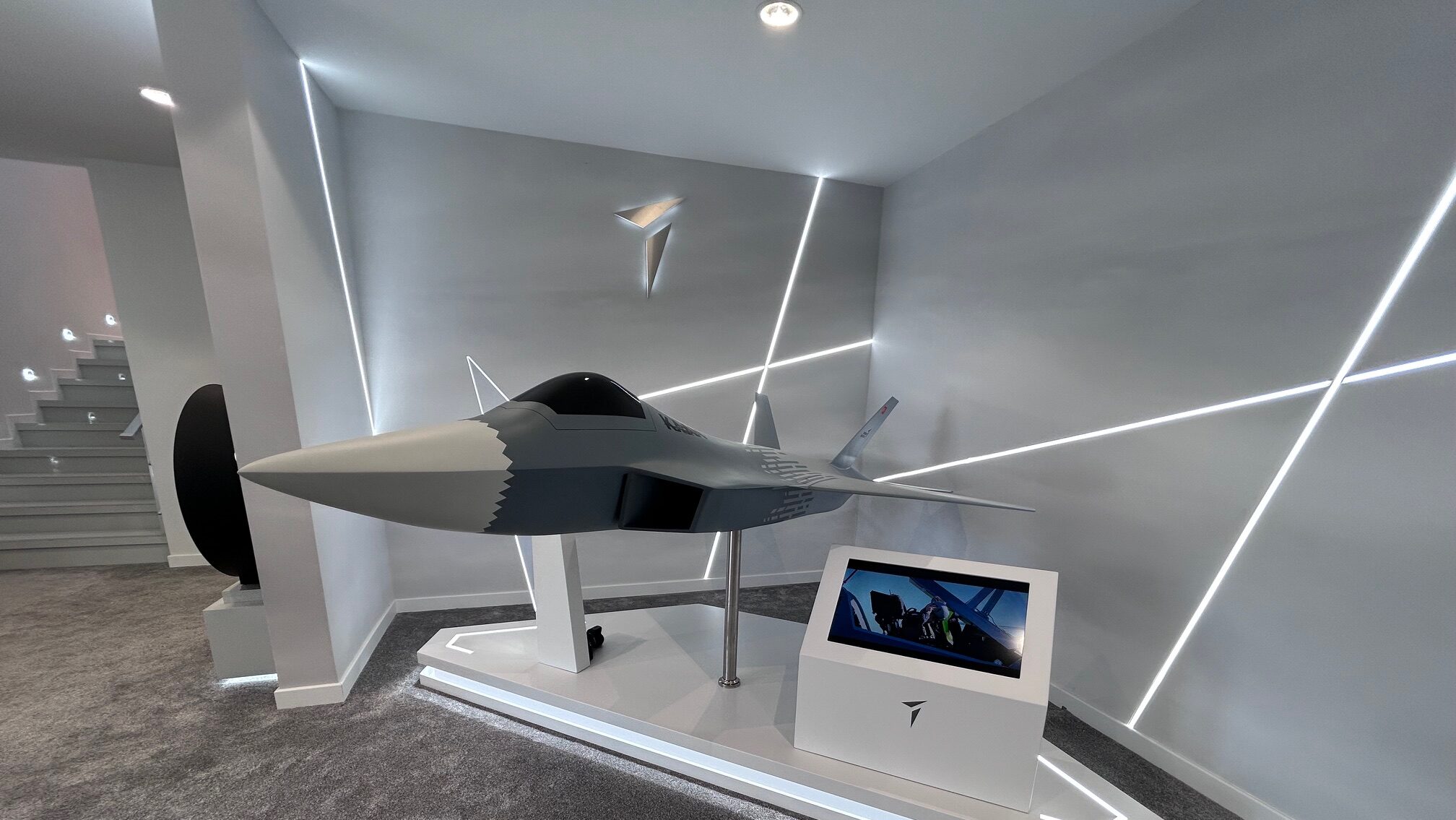
"We [have] already started working on” the new TF35000 turbofan engine, Mehmet Demiroğlu, general manager at TAI, told Breaking Defense at Le Bourget, adding that work is being done jointly by Tusas Engine Industries (TEI) and TRMotor. As part of the system’s preliminary design phase, a “conceptual design is almost done,” he added, “and then it will go to initial prototyping maybe by the end of the year."
Additionally, Demiroğlu said that “some early testing” of the powerplant is planned in 2026 and integration on KAAN could be a reality starting in 2032.
This should recalibrate the expectations after Kotil's frequent, unrealistic 2028 FF timeline.
 breakingdefense.com
"We [have] already started working on” the new TF35000 turbofan engine, Mehmet Demiroğlu, general manager at TAI, told Breaking Defense at Le Bourget, adding that work is being done jointly by Tusas Engine Industries (TEI) and TRMotor. As part of the system’s preliminary design phase, a “conceptual design is almost done,” he added, “and then it will go to initial prototyping maybe by the end of the year."
Additionally, Demiroğlu said that “some early testing” of the powerplant is planned in 2026 and integration on KAAN could be a reality starting in 2032.
This should recalibrate the expectations after Kotil's frequent, unrealistic 2028 FF timeline.
Turkish Aerospace eyes full development of local KAAN fighter jet engine by 2032 - Breaking Defense
KAAN flight tests currently feature General Electric's F110 turbofan engine, but Ankara has long prioritized a local alternative to reduce dependency on overseas suppliers.


From TAI CEO:
"We [have] already started working on” the new TF35000 turbofan engine, Mehmet Demiroğlu, general manager at TAI, told Breaking Defense at Le Bourget, adding that work is being done jointly by Tusas Engine Industries (TEI) and TRMotor. As part of the system’s preliminary design phase, a “conceptual design is almost done,” he added, “and then it will go to initial prototyping maybe by the end of the year."
Additionally, Demiroğlu said that “some early testing” of the powerplant is planned in 2026 and integration on KAAN could be a reality starting in 2032.
This should recalibrate the expectations after Kotil's frequent, unrealistic 2028 FF timeline.
Turkish Aerospace eyes full development of local KAAN fighter jet engine by 2032 - Breaking Defense
KAAN flight tests currently feature General Electric's F110 turbofan engine, but Ankara has long prioritized a local alternative to reduce dependency on overseas suppliers.
This is in line with the Indonesian orders...


What wasn't it always 2032?From TAI CEO:
"We [have] already started working on” the new TF35000 turbofan engine, Mehmet Demiroğlu, general manager at TAI, told Breaking Defense at Le Bourget, adding that work is being done jointly by Tusas Engine Industries (TEI) and TRMotor. As part of the system’s preliminary design phase, a “conceptual design is almost done,” he added, “and then it will go to initial prototyping maybe by the end of the year."
Additionally, Demiroğlu said that “some early testing” of the powerplant is planned in 2026 and integration on KAAN could be a reality starting in 2032.
This should recalibrate the expectations after Kotil's frequent, unrealistic 2028 FF timeline.
Turkish Aerospace eyes full development of local KAAN fighter jet engine by 2032 - Breaking Defense
KAAN flight tests currently feature General Electric's F110 turbofan engine, but Ankara has long prioritized a local alternative to reduce dependency on overseas suppliers.
2028/2029 was meant to be the first time it was tested alongside an General Electric F110 engine if i remenber currently.
integration on KAAN means it will be tested alongside F110.What wasn't it always 2032?
2028/2029 was meant to be the first time it was tested alongside an General Electric F110 engine if i remenber currently.
btw, he says integration, not first flight. the latter could be in the same year or later depending on its readiness.

Yes, you remember it correctly, and that hasn't changed. In fact, the TAI CEO's mention of early tests in (by the end of) 2026 is confirmation of that. We announced here that early tests might start in 2026, when no other forum or news outlet reported. Increased interest in KAAN project also shows that possible customers are convinced about the roadmap, and the engine project is on track. According to the current roadmap/projection, flight tests will start in the first half of 2030 at the worst-case scenario. Mechanical fitting/integration will start in late 2028 at the earliest.What wasn't it always 2032?
2028/2029 was meant to be the first time it was tested alongside an General Electric F110 engine if i remenber currently.
BTW mass production contract of TS-1400 might be signed this year or early 2026. There is a slim chance it might be signed at IDEF. The certification process is mostly completed.

Pokemonte13
Contributor
isin't gökbeys second package in 2028 by the way they increased the first package to 26 or something like that and were are they?Yes, you remember it correctly, and that hasn't changed. In fact, the TAI CEO's mention of early tests in (by the end of) 2026 is confirmation of that. We announced here that early tests might start in 2026, when no other forum or news outlet reported. Increased interest in KAAN project also shows that possible customers are convinced about the roadmap, and the engine project is on track. According to the current roadmap/projection, flight tests will start in the first half of 2030 at the worst-case scenario. Mechanical fitting/integration will start in late 2028 at the earliest.
BTW mass production contract of TS-1400 might be signed this year or early 2026. There is a slim chance it might be signed at IDEF. The certification process is mostly completed.
Likely so, which is in line with recent indications of the progress which we had discussed recently. People should take into account that you can rush development and go to deployment before the engine reached full maturity. An engine which is expected to run before 2027 can be made to operate satisfactorily for deployment in first half of 2029. Two and a half year time for improvements before going into production should be sufficient given the engine is already needed urgently as it is our only viable option to take us to an operational fighter. You don't wait until everything becomes perfect as it is not a plane to use for leisure activity, it is a plane that will be used to take risks by our heroes. Further development will continue while the engine is already in production and upgrades be made as progress is made. Any extra investment in this development will make the engine more mature before deployment. I would take 2029 deployment as a firm date and only consider how mature the engine will be a variable. We deploy no matter how mature it is, that is.I wonder if he meant the prototype back then. If yes, this means TEI/TRMOTOR will pull off this feat without any delays. (I am only talking about the prototype)
Why don't we cooporate with R-R on engine projects which we are lacking right now?
"United Kingdom: Türkiye is a key partner for the UK through strong military integration and defense industry cooperation."

İngiltere'den son dakika Türkiye duyurusu! 'Kilit ortak'
Haber 7 - Son dakika haberi... İngiltere'de hükümetin yayımladığı yeni ulusal güvenlik stratejisi belgesinde, Türkiye'nin güçlü askeri entegrasyon ve savunma sanayi iş birliği sayesinde İngiltere için kilit ortak olduğu bildirildi.www.haber7.com
They do not provide technology transfer.
We want to export kaan to pakistan and others
Do we need technology transfer? Our propulsion related companies can already develop Turbojet/Turbofan/Turboshaft engine on their own. But those companies also have their hands full with projects and Türkiye doesn't have many aviation engine related engineers i guess.
So i am more talking about to offload the work to R-R.


